The short answer
HUD's fiscal 2027 Fair Market Rents took effect October 1, 2026, except in 12 areas and two ZIP codes where local agencies requesting a reevaluation chose to keep fiscal 2026 FMRs. FMRs are HUD's estimate of rent plus utilities for modest, standard-quality units. The published two-bedroom FMR rose in 82% of areas, median +4.2%, and fell in 18%, including several large Sun Belt metros.
Key takeaways
What is a Fair Market Rent?
A Fair Market Rent (FMR) is HUD's estimate of what a modest, standard-quality rental costs in an area. The target is gross rent, meaning rent plus utilities, at the 40th percentile of what recent movers paid: about 40% of those households paid less, and about 60% paid more.
HUD publishes FMRs at least once a year for each metropolitan FMR area and each non-metropolitan county, in five unit sizes from studio to four bedrooms. The fiscal 2027 figures were published in the Federal Register on September 1, 2026 (91 FR 56156).
Who uses Fair Market Rents?
HUD programs use them. Under HUD's voucher rules (24 CFR 982.503), the FMR is the starting point for the payment standard, and the payment standard in turn limits the monthly subsidy a voucher household can receive. The local public housing agency sets the payment standard, so it is not the same number as the FMR.
HUD also uses FMRs for some project-based Section 8 contract renewals, the Moderate Rehabilitation Single Room Occupancy program, Continuum of Care rent limits and public housing flat rents, among other uses listed in the notice.
For a landlord, an FMR is a published reference point for modest rents in an area, not a market-rate comparable for a specific unit.
What changed for fiscal 2027?
Most areas got an increase, but not all. Comparing each of the 2,606 FY 2027 FMR areas with its revised FY 2026 figure, the two-bedroom FMR rose in 82.0% of areas and fell in 17.9%. The median area rose +4.2%.
Weighting by population gives a smaller number. The areas where the FMR fell are home to 36.3% of the population in the file, and the population-weighted median change was +2.1%. The population-weighted average two-bedroom FMR rose from $1,724 to $1,750 (+1.5%).
Annual decreases are capped. HUD's rules do not let an FMR fall more than 10% from the prior year, and 44 areas fell by 9.5% or more, at or near that limit.
These figures use the published FY 2027 values for every area, including the 12 areas where FY 2026 FMRs remain in effect for now. Counting those areas as unchanged instead, 81.9% of areas rose and 17.5% fell, and the medians stay at +4.2% by area and +2.1% by population.
| Change | FMR areas | Share of areas | Share of population |
|---|---|---|---|
| Down more than 5% | 132 | 5.1% | 11.3% |
| Down up to 5% | 334 | 12.8% | 25.0% |
| Unchanged | 4 | 0.2% | 0.1% |
| Up less than 5% | 1,062 | 40.8% | 35.8% |
| Up 5% to under 10% | 791 | 30.4% | 18.2% |
| Up 10% or more | 283 | 10.9% | 9.6% |
How did FMRs change in the largest metros?
The 10 most populous metro FMR areas split. 5 rose and 5 fell. Chicago-Joliet-Naperville, IL had the largest increase (+12.9%) and Dallas, TX the largest decline (−6.4%).
These are area-wide figures. HUD also publishes Small Area FMRs, set by ZIP code, for metropolitan and non-metropolitan areas, and it requires voucher programs in some metro areas to use them.
| FMR area | FY 2026 (revised) | FY 2027 | Change |
|---|---|---|---|
| New York, NY | $2,910 | $2,971 | +2.1% |
| Los Angeles-Long Beach-Glendale, CA | $2,903 | $2,964 | +2.1% |
| Chicago-Joliet-Naperville, IL | $1,781 | $2,011 | +12.9% |
| Houston-The Woodlands-Sugar Land, TX | $1,573 | $1,497 | −4.8% |
| Philadelphia-Camden-Wilmington, PA-NJ-DE-MD | $1,810 | $1,860 | +2.8% |
| Washington-Arlington-Alexandria, DC-VA-MD | $2,246 | $2,438 | +8.5% |
| Atlanta-Sandy Springs-Roswell, GA | $1,820 | $1,762 | −3.2% |
| Dallas, TX | $1,931 | $1,807 | −6.4% |
| Phoenix-Mesa-Chandler, AZ | $1,839 | $1,734 | −5.7% |
| Riverside-San Bernardino-Ontario, CA | $2,201 | $2,103 | −4.5% |
Where are the fiscal 2027 FMRs not in effect yet?
In 12 FMR areas and two ZIP codes in Grafton County, New Hampshire, housing agencies filed valid reevaluation requests and chose to keep the fiscal 2026 FMRs during the review, so fiscal 2026 FMRs still apply there as of October 1, 2026. The notice lets requesting areas choose either year's FMRs while HUD reviews them.
In 11 of the 12 areas the published fiscal 2027 two-bedroom FMR is lower than fiscal 2026, so the decrease shown below is not in effect while HUD reviews it. Five other areas with valid requests (Coos County, OR; Curry County, OR; Seattle-Bellevue, WA; Yolo, CA; San Francisco, CA) and one Hartford-area ZIP code are using the fiscal 2027 FMRs, as is Grand Rapids, Michigan, where HUD also received a request.
| FMR area | FY 2026 (in effect) | FY 2027 (published, not in effect) | Published change |
|---|---|---|---|
| Davenport-Moline-Rock Island, IA-IL | $1,143 | $1,056 | −7.6% |
| Erie, PA | $1,212 | $1,091 | −10.0% |
| Madison, WI | $1,694 | $1,565 | −7.6% |
| Merrimack County, NH | $1,974 | $1,800 | −8.8% |
| Milwaukee-Waukesha, WI | $1,338 | $1,263 | −5.6% |
| Oxnard-Thousand Oaks-Ventura, CA | $2,693 | $2,424 | −10.0% |
| Pinehurst-Southern Pines, NC | $1,358 | $1,223 | −9.9% |
| Portsmouth-Rochester, NH | $2,194 | $2,093 | −4.6% |
| San Luis Obispo-Paso Robles, CA | $2,671 | $2,720 | +1.8% |
| San Jose-Sunnyvale-Santa Clara, CA | $3,483 | $3,272 | −6.1% |
| Santa Ana-Anaheim-Irvine, CA | $3,236 | $3,057 | −5.5% |
| Santa Maria-Santa Barbara, CA | $3,124 | $3,106 | −0.6% |
Did every unit size change the same way?
Smaller units rose a little more. The median change across FMR areas ranged from +4.7% for studios to +3.7% for four-bedroom units.
| Unit size | Median change |
|---|---|
| Studio (0 bedrooms) | +4.7% |
| 1 bedroom | +4.5% |
| 2 bedrooms | +4.2% |
| 3 bedrooms | +3.8% |
| 4 bedrooms | +3.7% |
How do I find the FMR for my area?
Use HUD USER's FY 2027 FMR documentation system, which lets you pick a state and county or metro area and shows the FMR for each unit size along with how HUD calculated it. HUD USER also posts the full county-level spreadsheet and the Small Area FMR file.
If you work with a voucher holder, ask the local public housing agency for its current payment standards, which can differ from the FMR.
What this means for landlords
These are considerations, not legal or financial advice. Rules on voucher programs and tenant income sources vary by state and locality.
- An FMR is a 40th-percentile estimate for modest units. Price a specific unit against current local listings and recent leases instead.
- If a tenant uses a voucher, the change that matters is in your housing agency's payment standard, which agencies set based on the FMR. Check the agency's current schedule.
- FMRs start from 2020–2024 survey data that HUD trends forward to the fiscal year. Compare them with current local listings and recent leases, and see our housing market page for national rent trends.
- Where the FMR fell, as in Dallas, TX, ask your housing agency whether its payment standards are changing. The agency decides that, not HUD's published number alone.
Methodology
We downloaded HUD's FY 2027 county-level FMR file and the revised FY 2026 file and grouped county rows into FMR areas using HUD's area code. Every county in an area carries the same FMR, which we checked. We compared the two-bedroom FMR in each of the 2,606 FY 2027 areas with the same area's FY 2026 value.
Population weights use the population field in HUD's FY 2027 file. Medians and shares count each FMR area once unless stated as population-weighted.
HUD folded 16 fiscal 2026 areas into larger areas for fiscal 2027: 12 Connecticut towns into the Hartford and Waterbury-Shelton areas, and 4 Puerto Rico municipios into the Puerto Rico non-metropolitan area. We compare each fiscal 2027 area with the fiscal 2026 value for the same area code, so the folded areas' own fiscal 2026 values are not part of the comparison.
We matched HUD's reevaluation list to the data file by area name. Two areas (Oxnard-Thousand Oaks-Ventura, CA and San Luis Obispo-Paso Robles, CA) are labeled differently in the list and were matched on place name and state. Area names on this page come from HUD's data file.
HUD's own method, per the notice, starts from 2020–2024 five-year American Community Survey rents, adjusts for recent movers using 2024 one-year data, and trends the result forward. For 17 named areas, including New York and Los Angeles, and all areas of Montana, HUD based the FMRs on local rent surveys from 2022 to 2026 instead of that survey data. For FY 2027 HUD also changed how it estimates utility cost growth, since BLS no longer publishes the local utility price index HUD relied on before.
Limitations
Keep these limits in mind.
- In the 12 areas and two ZIP codes listed above, fiscal 2026 FMRs apply only while HUD reevaluates. Per the notice, agencies must send survey data by January 8, 2027. Where none arrives, HUD will list those areas by January 15, 2027 and the fiscal 2027 FMRs take effect. HUD expects to post revised FMRs in April 2027.
- HUD changed some area definitions between years. FY 2026 had 2,622 FMR areas and FY 2027 has 2,606; this comparison covers the FY 2027 areas.
- Changes are in nominal dollars.
- We compare against the revised FY 2026 FMRs, which took effect May 21, 2026. 7 areas differ from the original FY 2026 release.
- This page summarizes national data. It does not interpret program rules for a specific property or tenant.
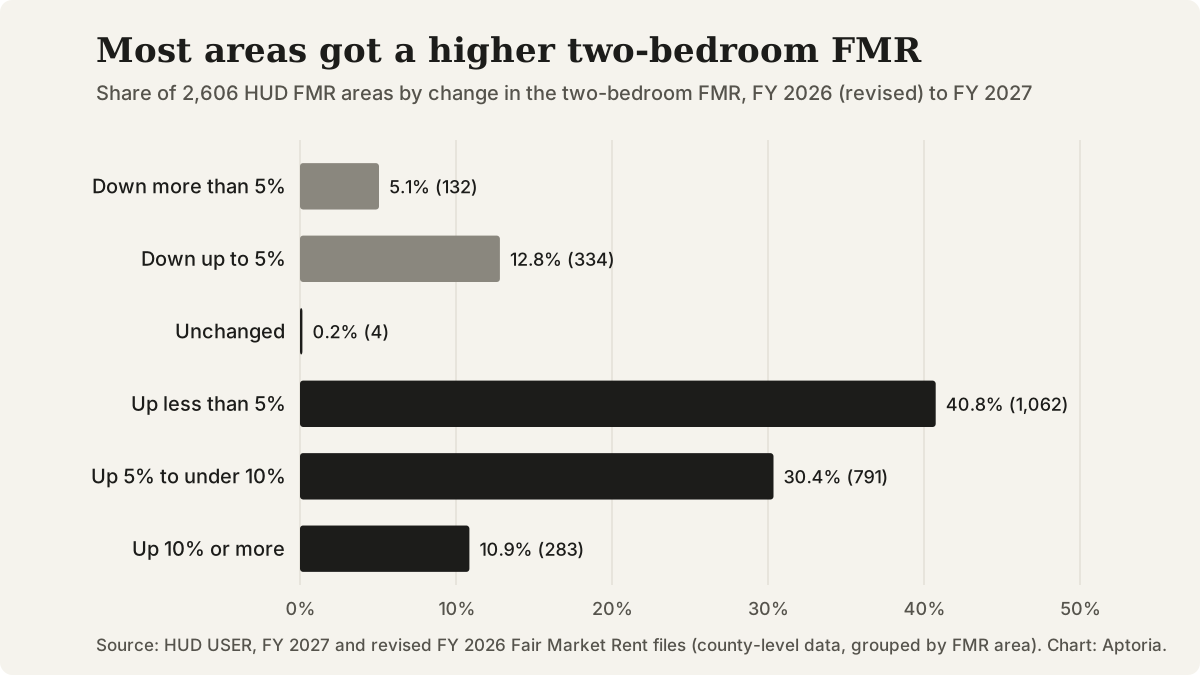
Share of HUD FMR areas by change in the two-bedroom FMR, FY 2026 (revised) to FY 2027. Source: HUD USER Fair Market Rent files.
Questions that come up
Is the Fair Market Rent the same as a voucher payment standard?
No. The FMR is HUD's input; the local housing agency turns it into a payment standard, and that standard caps how much the voucher can pay toward rent. Ask the agency for its current schedule.
Why is my area's FMR lower than rents I see listed?
An FMR is a 40th-percentile figure for rent plus utilities, based on what households who moved recently paid for decent, modest units across a whole area. A listing is one asking rent for one unit, so the two measure different things.
What is a Small Area FMR?
It is an FMR set for a ZIP code rather than a whole FMR area. HUD publishes them for metropolitan and non-metropolitan areas and requires voucher programs in some metro areas to use them.
When will the next Fair Market Rents come out?
HUD must publish FMRs at least once a year, effective at the start of the federal fiscal year on October 1. We will update this page when HUD publishes the fiscal 2028 figures.
Sources and references
Follow each source to check the underlying claim. Access checks and professional review are different steps.