The short answer
Mostly straight from a bank account. In the Atlanta Fed's October 2025 payment diary, online banking bill pay (25%) and bank account number payments (24%) were the most common ways consumers paid bills, followed by debit cards (20%) and credit cards (14%). Checks were 6% of bill payments and cash 4%. Only 5% of consumers most prefer paying bills by check, down from 17% in 2016.
Key takeaways
The key numbers
In October 2025, consumers made about 47 payments a month on average, about 10 of them bills. Electronic payments from a bank account through the ACH system, online banking bill pay and bank account number payments, were 49% of bill payments by number and 60% by value. Adding debit cards, which also draw on a bank account, gives about 69% of bill payments (our sum). Cards (debit, credit and prepaid) were 34% by number but only 18% by value.
Online banking bill pay is a payment you send from your bank's website or app. A bank account number payment is one where you pay by giving your bank's routing number and your account number, for example by entering them in a payee's online form (our example). The two shares are within each other's 95% intervals.
| Payment method | Share by number | 95% interval | Share by value |
|---|---|---|---|
| Online banking bill pay (from your bank's website or app) | 25.0% | 23.0 to 27.0 | 29.9% |
| Bank account number payment (you give your routing and account numbers) | 23.8% | 22.0 to 25.6 | 30.3% |
| Debit card | 19.7% | 17.8 to 21.6 | 10.7% |
| Credit card | 14.3% | 12.9 to 15.7 | 7.4% |
| Check | 6.1% | 5.1 to 7.0 | 10.5% |
| Cash | 4.5% | 3.5 to 5.4 | 3.9% |
| Account-to-account transfer | 2.6% | 1.9 to 3.2 | 4.2% |
| Money order | 0.5% | 0.2 to 0.8 | 0.4% |
| Payment app balance (PayPal, Venmo, Zelle) | 0.6% | 0.4 to 0.9 | 0.6% |
What does the diary show about rent?
Rent is a large payment made rarely. Payments in the diary's rent category were 1.2% of all payments by number but 9.4% by dollar value. Averaged over all consumers, including those who own or live rent-free, that is about 0.6 rent payments per consumer per month. Dividing the Atlanta Fed's rent value by its rent count gives an average rent payment of about $1,076 (our calculation, which may include partial payments and shares of rent split between roommates).
The rent category covers rent for apartments, homes or other buildings and payments to real estate companies and property managers. The Atlanta Fed does not publish rent payments by payment method. The public transaction file has 432 rent transactions (363 of them dated in October, our count). Our own tabulation of that file did not reproduce the published totals, so this page does not estimate rent by method.
What the diary does show is how bills in general are paid. Most were paid remotely rather than in person: 87% of bill payments by number, by the Atlanta Fed's count.
| Measure | Estimate | 95% interval |
|---|---|---|
| Rent payments per consumer per month | 0.6 | 0.5 to 0.7 |
| Share of all payments by number | 1.2% | 1.0 to 1.5 |
| Share of all payments by dollar value | 9.4% | 6.4 to 12.5 |
| Average rent payment (our calculation) | $1,076 | Not published |
How many people still pay by check or cash?
Fewer each year. 65% of consumers had checks in 2025, down from 82% in 2015, and 33% wrote at least one check in the past 30 days, down from 50% in 2020. The Atlanta Fed reports that the share using checks in the past 30 days was significantly lower than in 2024. The share who most prefer to pay bills by check fell from 17% in 2016 to 5% in 2025.
Checks still carry larger bills: they were 6% of bill payments by number but 11% by value. The average bill payment of any kind was about $422.
Cash remains common for purchases but not for bills. 81% of consumers used cash in the past 30 days, yet cash was 4% of bill payments and 5% of consumers most prefer it for bills. FedCash, the Federal Reserve service that published a summary of the same diary, reports that 90% of consumers plan to continue using cash in the future.
| Year | Have checks | Wrote a check in past 30 days | Most prefer checks for bills | Most prefer a credit card for bills |
|---|---|---|---|---|
| 2015 | 82% | Not in table | 16% | 10% |
| 2018 | 78% | Not in table | 13% | 14% |
| 2020 | 77% | 50% | 11% | 15% |
| 2022 | 77% | 46% | 8% | 18% |
| 2024 | 67% | 35% | 6% | 19% |
| 2025 | 65% | 33% | 5% | 21% |
How do people prefer to pay bills, and do they use payment apps?
Asked which method they most prefer for paying bills, 27% of consumers chose online banking bill pay, 26% a debit card, 21% a credit card and 13% a bank account number payment. The share preferring a credit card rose from 10% in 2015.
Payment apps are widely held. 35% of consumers had a Venmo account, 33% had Zelle (up from 11% in 2019), 33% had PayPal and 21% had Cash App. In the diary, payments made with money stored in an app were 0.6% of bill payments. The Atlanta Fed notes that this category covers only payments made with money stored in an app. An app payment funded straight from a bank account or card is likely counted under another method (our reading). 95% of consumers had a checking account.
| Account or method | Share of consumers | 95% interval |
|---|---|---|
| Checking account | 95% | 94.0 to 95.6 |
| Debit card | 90% | 89.4 to 91.5 |
| Credit card | 80% | 78.9 to 81.8 |
| Checks | 65% | 63.6 to 67.1 |
| Venmo account | 35% | 32.9 to 36.2 |
| Zelle | 33% | 31.5 to 34.9 |
| PayPal account | 33% | 30.9 to 34.1 |
| Cash App account | 21% | 19.7 to 22.7 |
What this means for landlords
These are considerations for setting up rent payment options, not recommendations.
- About half of bill payments (49%) were paid electronically from a bank account, so many tenants are used to paying a recurring bill by bank transfer or online bill pay.
- A third of consumers (33%) still wrote a check in the past month, and checks were used more for larger bills. Whether to accept checks is a choice to weigh against your own tenants' habits and your record-keeping.
- Cards were 34% of bill payments. If you accept cards, the chargeback glossary entry linked below explains how card disputes work.
- If you accept payment apps, keep the same records as for other payments: the date, amount, payer and which month the payment covers.
- These are national figures for all consumers, not only renters, and they do not describe any one tenant. Rules on accepted payment methods and fees vary by state and locality, so check the rules where your rental is.
Methodology
The Survey and Diary of Consumer Payment Choice is run each October by the Federal Reserve Banks of Atlanta and Boston and Federal Reserve Financial Services, with the Understanding America Study panel at the University of Southern California. In 2025, 6,079 respondents completed both the survey and a diary of every payment over a randomly assigned three-day period between September 29 and November 2. Weighted results describe US consumers in October 2025.
Every share, count and interval on this page is the Atlanta Fed's published estimate or 95% confidence interval, rounded once, except the sums and the average rent payment marked as ours, and the 87% remote share, which is from the report text. The average rent payment is the published rent value per consumer divided by the published rent count per consumer. We describe a change over time only where the 95% intervals for the two years do not overlap or where the Atlanta Fed reports the change as significant.
We also tabulated the public transaction data to look at rent payments by method, but our totals did not exactly match the published tables, so we do not report that breakdown.
Limitations
Keep these limits in mind when using the figures.
- The survey covers all consumers, not only renters, and no published table shows how rent itself is paid.
- Rent is paid about once a month, so a three-day diary records few rent payments, and the rent estimates have wide intervals; the value share's interval runs from 6.4% to 12.5%.
- The Atlanta Fed notes that consumer payments are not the same as expenditures: they include transfers between accounts and tax payments and leave out payments others make on a consumer's behalf.
- The payment-app category includes only payments from money stored in an app, so it likely understates how often people pay through apps.
- The Atlanta Fed changed how it defines adoption of cash, money orders and electronic payments in 2020 and 2021, so this page does not compare those across that break; the check series has no marked break.
- The figures describe October 2025 only.
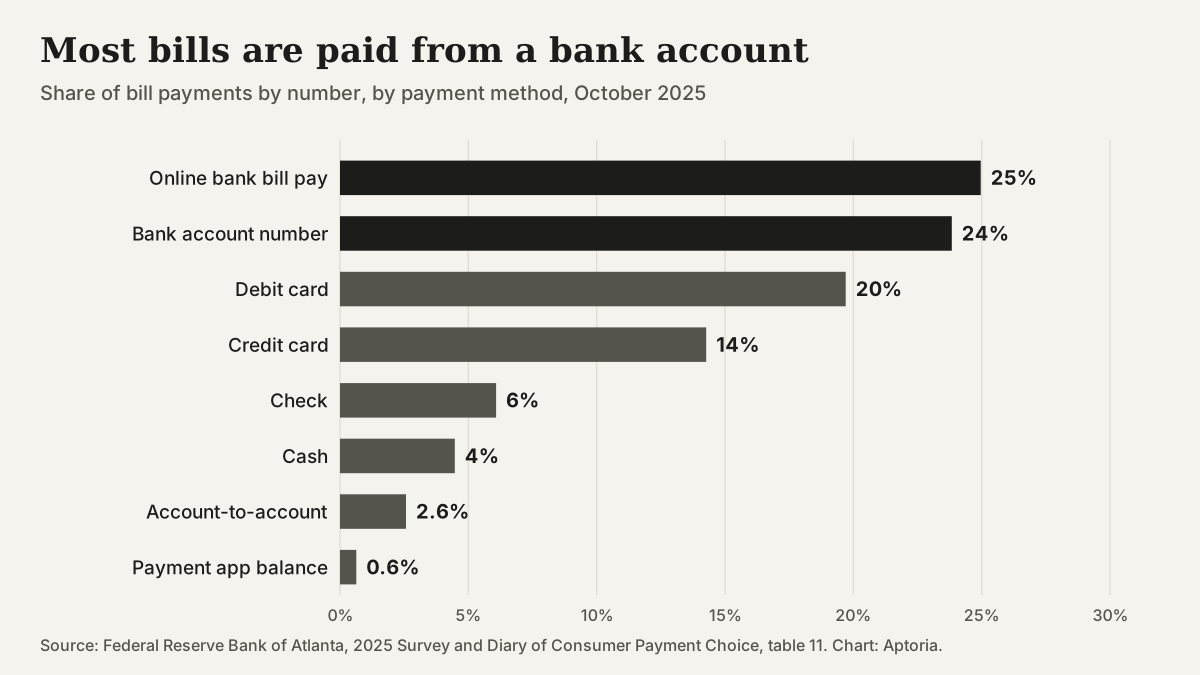
Share of bill payments by number, by payment method, October 2025. Source: Federal Reserve Bank of Atlanta, 2025 Survey and Diary of Consumer Payment Choice, table 11. Shares below 3% are shown to one decimal.
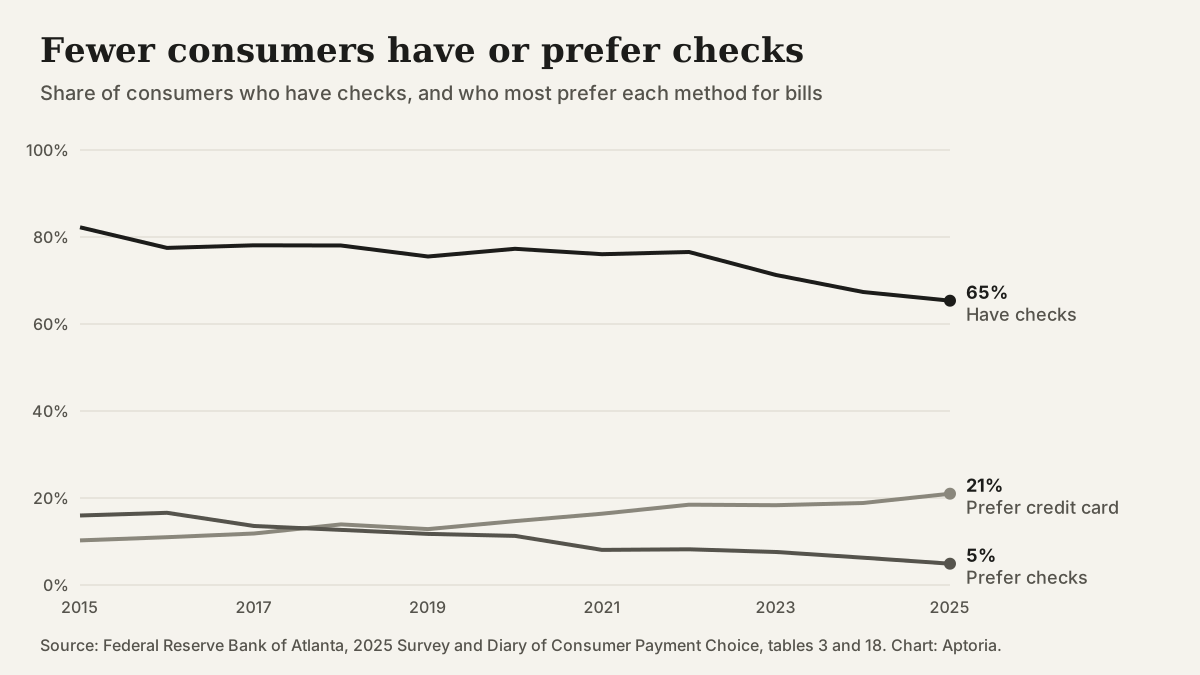
Share of consumers who have checks, and who most prefer checks or a credit card for paying bills, 2015 to 2025. Source: Federal Reserve Bank of Atlanta, 2025 Survey and Diary of Consumer Payment Choice, tables 3 and 18.
Questions that come up
Does this page show how renters pay their rent?
Not directly. The Atlanta Fed publishes rent as a payee category for all consumers, with its count and value, but not by payment method. The 2025 diary recorded only a few hundred rent payments, and our own tabulation did not reproduce the published totals, so we do not report a breakdown.
Is a bank account number payment the same as ACH?
It is one kind of ACH payment. The Atlanta Fed counts both bank account number payments, where you pay by giving your routing and account numbers, and online banking bill pay, where you send the payment from your bank, as electronic payments through the ACH system.
Does this survey cover people without a bank account?
It includes them, but it is not designed to study them in depth. 95% of consumers had a checking account in 2025, so the bill-payment figures mostly reflect people who bank.
How often is this data updated?
The diary is run every October. The 2025 results were published in May 2026; if the schedule holds, figures for October 2026 would follow around May 2027.
Sources and references
Follow each source to check the underlying claim. Access checks and professional review are different steps.