The short answer
Mostly renters. In EIA's preliminary 2024 survey data, 78.9% of renter households paid all their energy bills directly, 12.7% had some energy included in the rent and 8.2% had all of it included. Inclusion is more common in apartment buildings: about 26% of renters in buildings with five or more units had some or all energy in the rent, against 11% in single-family homes.
Key takeaways
The key numbers
The Residential Energy Consumption Survey asks households, separately for electricity, natural gas, propane and fuel oil, whether they pay for all of it, whether all of it is included in the rent or condo fee, or whether some is paid each way. EIA's tables group households by one combined payment method, and we apply the same definition. Shares in the table are our tabulation of EIA's preliminary 2024 microdata.
A very small group paid some other way, for example through a housing authority or a relative. It is too small to show, so rows may not add to exactly 100%. Estimates that fail EIA's publication standard are marked as not shown.
| Type of home | Renter households | All energy paid by household | Some energy included in rent | All energy included in rent |
|---|---|---|---|---|
| Single-family homes | 11.5 million | 88.3% (±1.9) | 5.1% (±1.3) | 6.4% (±1.2) |
| Apartments in buildings with 2 to 4 units | 8.4 million | 78.4% (±2.9) | 13.4% (±2.3) | 8.0% (±1.8) |
| Apartments in buildings with 5 or more units | 21.5 million | 73.7% (±1.6) | 16.7% (±1.4) | 9.5% (±1.1) |
| Mobile homes | 1.5 million | 85.0% (±5.3) | 10.2% (±4.6) | Not shown (too few responses) |
| All renter households | 43.0 million | 78.9% (±1.1) | 12.7% (±0.9) | 8.2% (±0.7) |
How often is energy included in the rent?
About one in five renter households (20.9%) had at least some of its energy included in the rent in 2024. That share was 11% in rented single-family homes, 21% in apartments in two- to four-unit buildings and 26% in buildings with five or more units. Each of those differences is statistically significant.
The 2024 figure is not significantly different from the 2020 survey, when 21.6% of renter households had some or all energy included. EIA's 2024 figures are preliminary.
Owners almost always pay their own energy bills: 98.0% of owner households did in 2024. The rest had some or all energy covered by a condo fee, or paid another way.
Which utilities are most often included?
Natural gas and electricity are the fuels most often included in the rent by number of households: about 5.6 million renter households had gas at least partly included and 5.2 million had electricity. About half of renter households (51%) report natural gas service, and 25% of those had some or all of it included in the rent, against 12% for electricity. Among the households that use them, fuel oil is included more often (about 64%) and propane somewhat more often (about 32%), but few renters use either.
The gap is widest in larger buildings. In apartments in buildings with five or more units, 37% of gas-using renter households had gas at least partly in the rent, and 32% had all of it included, against 14% with electricity at least partly included.
| Type of home | Electricity at least partly in rent (all renter households) | Natural gas at least partly in rent (renter households that use gas) |
|---|---|---|
| Single-family homes | 9.3% (±1.7) | 10.3% (±2.3) |
| Apartments in buildings with 2 to 4 units | 11.9% (±2.4) | 24.8% (±4.2) |
| Apartments in buildings with 5 or more units | 13.9% (±1.3) | 36.9% (±3.0) |
| Mobile homes | 9.6% (±4.6) | Not shown (too few responses) |
| All renter households | 12.1% (±0.9) | 25.5% (±1.6) |
Who pays for heat?
Electricity is renters' most common main heating fuel. In the 2020 survey, 48% of renter households heated mainly with electricity and 39% with natural gas. Among owners it was the other way around: 56% used natural gas and 28% electricity.
Among renter households that heated with electricity, natural gas, propane or fuel oil, 16% had the whole bill for their main heating fuel included in the rent (18% had it at least partly included) and 80% paid it themselves (our tabulation). Gas heat was included more often than electric heat: 21% of gas-heated renter households had all their gas in the rent, against 11% of electrically heated ones with all their electricity included.
Most renters use air conditioning (84%, against 91% of owners), and renters are about twice as likely to rely mainly on a window or wall unit (27% against 13%).
| Measure | Renter households | Owner households |
|---|---|---|
| Main heating fuel is electricity | 47.7% (±1.1) | 28.0% (±0.6) |
| Main heating fuel is natural gas | 39.4% (±1.2) | 56.4% (±0.7) |
| Main heating fuel is fuel oil or kerosene | 2.8% (±0.4) | 4.6% (±0.3) |
| Main heating fuel is propane | 1.6% (±0.3) | 5.5% (±0.4) |
| Does not use heating equipment | 7.9% (±0.8) | 3.1% (±0.3) |
| Uses air conditioning | 83.5% (±1.0) | 91.2% (±0.4) |
| Main air conditioner is a window or wall unit | 27.0% (±1.2) | 12.6% (±0.5) |
What do renters spend on energy?
EIA estimates that renter households spent an average of $1,372 on electricity, natural gas, propane and fuel oil in 2020, against $2,135 for owners. Renter households that paid all their own bills averaged $1,405 (±$20), or about $117 a month by our division.
Costs vary widely by type of home. Among renters paying all their own bills, those in single-family homes averaged $1,873 and those in buildings with five or more units $1,045.
EIA also estimates the cost of energy that is included in the rent, which averaged $1,200 for renter households with all energy included. These are 2020 costs. For how energy prices have changed since, see Are utility costs going up?
| Renter households | Average annual energy cost | 90% margin of error |
|---|---|---|
| All renter households (EIA published average) | $1,372 | ±$20 (our calculation) |
| Pay all their own energy bills | $1,405 | ±$20 |
| Pay all their own bills, single-family homes | $1,873 | ±$38 |
| Pay all their own bills, apartments with 2 to 4 units | $1,337 | ±$43 |
| Pay all their own bills, apartments with 5 or more units | $1,045 | ±$27 |
| All energy included in rent (our tabulation of EIA's imputed cost) | $1,200 | ±$55 |
What this means for landlords
These are considerations to weigh against your own rentals, not legal or financial advice.
- Including energy in the rent is a minority arrangement. About 8% of renter households have all their energy included, and about 88% of single-family renters pay all their own energy bills. If you include energy, your cost moves with tenants' usage and with energy prices.
- Stating in the listing and lease which utilities the tenant pays, and whose name each account is in, may help avoid confusion at move-in.
- Electric heat is common in rentals. Where tenants pay for electricity, winter heating bills fall on them, and a unit's past bills may help applicants budget.
- Rules on utility billing and submetering vary by state and locality. Check the rules where your rental is before billing tenants for utilities you pay.
- This survey does not cover water, sewer or trash, so it cannot show who usually pays those.
Methodology
We tabulated two EIA microdata files: the preliminary 2024 housing characteristics file (version 1, released May 21, 2026; 16,676 households) and the final 2020 file (version 7; 18,496 households). Estimates use EIA's final weight. Margins of error are 90% intervals from the 60 jackknife replicate weights, using EIA's stated 59/60 coefficient.
Before reporting anything new, the script reproduces EIA's published counts: every 2024 payment-method count by owner or renter status and by housing type in Tables HC9.2 and HC9.1, and the HC9.2 renter relative standard errors; and, for 2020, the payment-method counts and average costs in Table CE2.6 and the heating-fuel and air-conditioning counts in Tables HC6.2 and HC7.2. All match.
We follow EIA's definitions. The combined payment method uses the answers for electricity, natural gas, propane and fuel oil. Renter households include the small number living rent-free, as in EIA's tables, and single-family homes include attached homes such as townhouses. The heat measure matches each household's main heating fuel to the payment answer for that fuel.
We do not show estimates that fail EIA's publication standard (a relative standard error above 50 or fewer than 10 households). Statements that one share is larger than another were tested at the 90% level, treating the 2020 and 2024 samples as independent. Figures are rounded once, at display, and monthly costs are our division of annual averages.
Source: U.S. Energy Information AdministrationSource: U.S. Energy Information AdministrationSource: U.S. Energy Information AdministrationSource: U.S. Energy Information AdministrationSource: U.S. Energy Information AdministrationSource: U.S. Energy Information AdministrationSource: U.S. Energy Information AdministrationSource: U.S. Energy Information AdministrationSource: U.S. Energy Information AdministrationSource: U.S. Energy Information AdministrationSource: U.S. Energy Information Administration
Limitations
Keep these limits in mind.
- The 2024 figures are preliminary. EIA plans to release the full 2024 data, including heating fuels, energy use and costs, in spring 2027, and preliminary figures can change.
- Heating fuel, air conditioning and cost figures come from the 2020 survey, so they predate recent price changes.
- Who pays is reported by the household. Some respondents may not know exactly which charges their rent covers.
- The survey counts households, not landlords or rental units owned, so it cannot say how many landlords include utilities.
- The survey does not ask about water, sewer or trash.
- Figures are national. Practices differ by state, city and building, and this page does not show those differences.
- This page does not forecast utility costs.
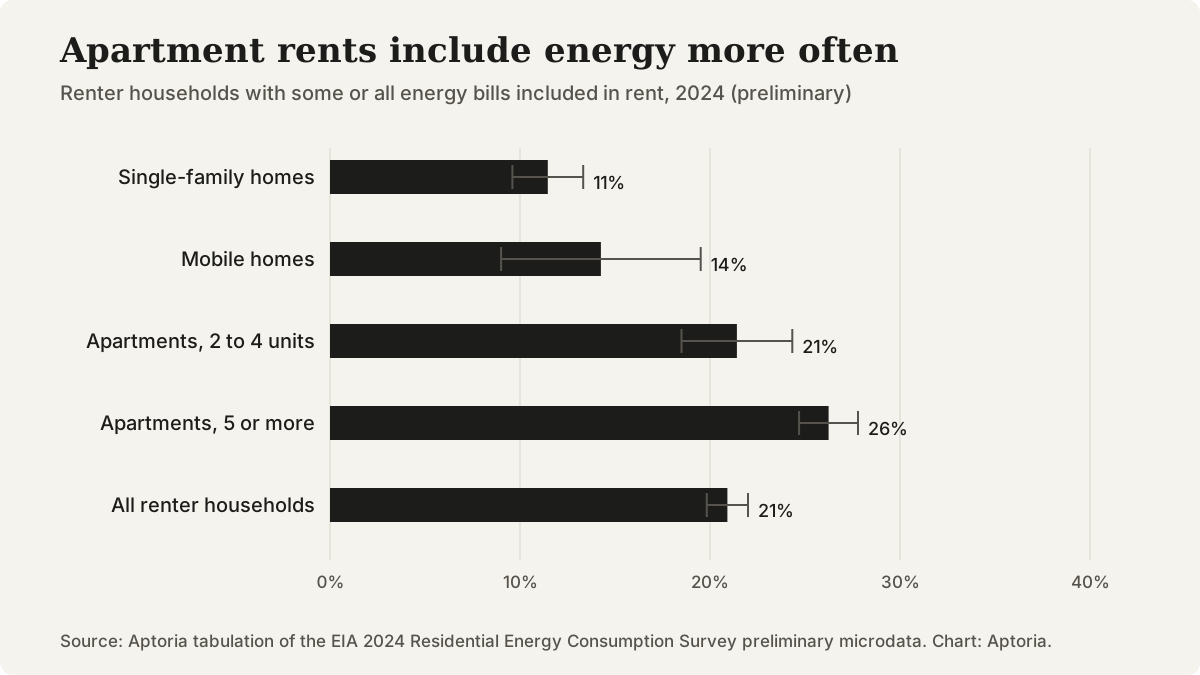
Share of renter households with some or all energy bills included in rent, by type of home, 2024 (preliminary). Source: Aptoria tabulation of EIA Residential Energy Consumption Survey microdata.
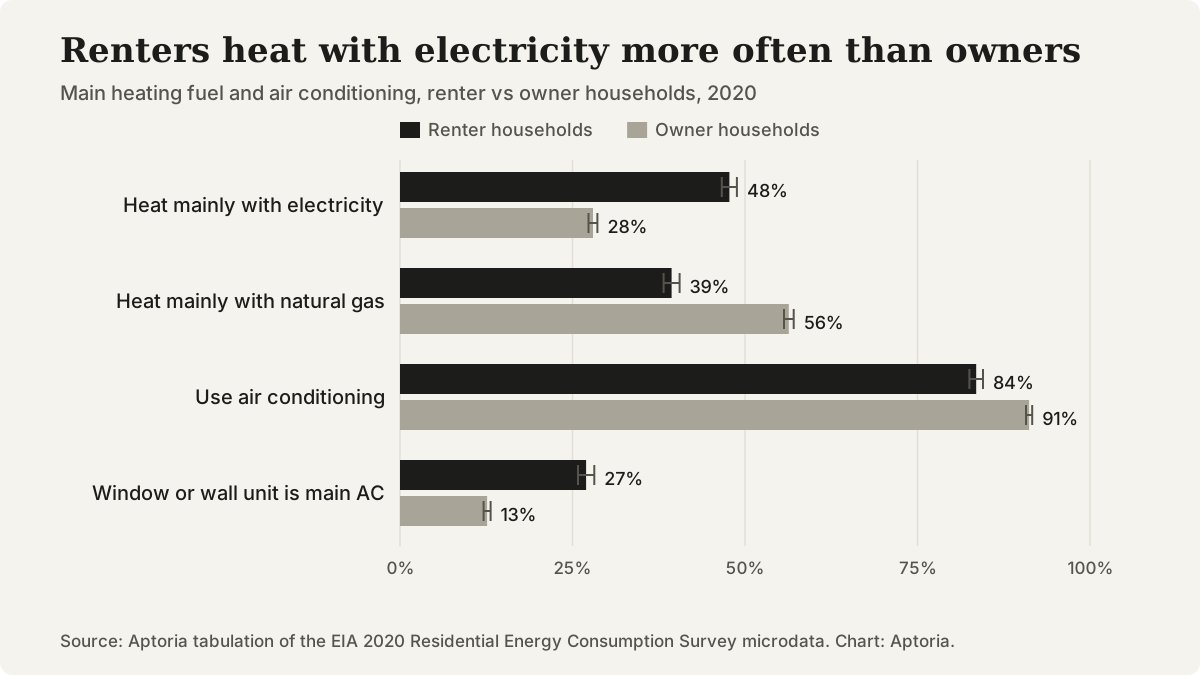
Main heating fuel and air conditioning, renter and owner households, 2020. Source: Aptoria tabulation of EIA Residential Energy Consumption Survey microdata.
Questions that come up
Does this page say whether a landlord must pay for utilities?
No. This page reports survey data on how renters' energy is paid, not legal requirements. Rules on utility billing and submetering vary by state and locality, so check the rules where your rental is before changing how utilities are billed.
Does included in rent mean the landlord pays the utility company?
In EIA's survey it means the household's electricity, gas, propane or fuel oil is covered by its rent or condo fee rather than billed to the household; the survey does not record who pays the supplier. Bills paid by a third party, such as a housing authority or a relative, are counted separately as some other method.
Why are there energy costs for homes where energy is included in the rent?
EIA estimates energy costs for every household, for electricity, natural gas, propane and fuel oil. Where a household does not pay its fuel supplier directly, EIA imputes the cost, so the average reflects what that energy cost, whoever paid it.
When will newer cost figures be available?
EIA says it plans to release the full 2024 survey, including energy consumption and expenditures, in spring 2027. Until then, 2020 is the latest year with survey-based household energy costs.
Sources and references
Follow each source to check the underlying claim. Access checks and professional review are different steps.