The short answer
The latest HUD annual report we found counts 8,521 fair housing complaints filed with HUD and its state and local partner agencies in fiscal year 2022. Disability was alleged in 59.5% of them, race in 28.8% and sex in 13.0%; a complaint can list several grounds. Filings were lower than the 10,293 of FY 2007, while disability complaints rose.
Key takeaways
The latest national numbers
HUD's FY 2022 State of Fair Housing Annual Report, the latest HUD annual report we found, counts 8,521 complaints filed under the Fair Housing Act in the fiscal year from October 1, 2021 to September 30, 2022. HUD filed 1,912 of them and state and local Fair Housing Assistance Program (FHAP) agencies filed 6,609, so FHAP agencies handled about 78% (our calculation).
Disability was the most common basis, alleged in 5,069 complaints (59.5%). Race followed with 2,457 (28.8%), then sex, retaliation, national origin and familial status. HUD counts a complaint under every basis it alleges, so the shares add up to more than 100%.
HUD's report lists retaliation separately: it is not one of the seven protected classes but is covered by Section 818 of the Act. HUD's FY 2022 report labels the sex row "sex (including gender identity and sexual orientation)" and describes a February 11, 2021 HUD memorandum interpreting the Act that way. A Federal Register notice published April 6, 2026 says HUD withdrew that memorandum effective September 17, 2025. This page reports the label as published and does not describe how federal law applies today.
| Basis | Complaints | Share of all complaints |
|---|---|---|
| Disability | 5,069 | 59.5% |
| Race | 2,457 | 28.8% |
| Sex | 1,107 | 13.0% |
| Retaliation | 1,065 | 12.5% |
| National origin | 765 | 9.0% |
| Familial status | 741 | 8.7% |
| Color | 354 | 4.2% |
| Religion | 183 | 2.1% |
How have complaint numbers changed?
In HUD's case file, complaints filed with HUD and FHAP agencies were highest in FY 2008 among the years shown here, at 10,586, and drifted down to 7,745 by FY 2019. HUD's annual reports show 7,575 in FY 2020, the lowest year on this page, then 8,403 in FY 2021 and 8,521 in FY 2022. HUD does not give a reason for these changes.
Complaints alleging disability moved the other way, from 4,472 in FY 2007 to 5,069 in FY 2022, the highest on this page. Their share of all complaints rose from 43.4% in FY 2007 (our calculation from the case file) to 59.5%.
Complaints alleging race fell from 3,811 in FY 2007 to 2,457 in FY 2022, and those alleging familial status from 1,480 to 741. Retaliation complaints rose from 601 to 1,065. These comparisons join two HUD sources, so treat small differences with care.
| Fiscal year | All complaints | Alleging disability | Source |
|---|---|---|---|
| 2007 | 10,293 | 4,472 | HUD case file (HUD028) |
| 2008 | 10,586 | 4,701 | HUD case file (HUD028) |
| 2010 | 10,164 | 4,848 | HUD case file (HUD028) |
| 2013 | 8,404 | 4,418 | HUD case file (HUD028) |
| 2016 | 8,460 | 4,950 | HUD case file (HUD028) |
| 2019 | 7,745 | 4,776 | HUD case file (HUD028) |
| 2020 | 7,575 | 4,634 | HUD annual reports (disability: FY 2022 report) |
| 2021 | 8,403 | 4,881 | HUD annual reports (disability: FY 2022 report) |
| 2022 | 8,521 | 5,069 | HUD annual reports (disability: FY 2022 report) |
Source: U.S. Department of Housing and Urban Development, Office of Fair Housing and Equal OpportunitySource: U.S. Department of Housing and Urban Development, Office of Fair Housing and Equal OpportunitySource: U.S. Department of Housing and Urban Development, Office of Fair Housing and Equal OpportunitySource: U.S. Department of Housing and Urban Development, Office of Fair Housing and Equal Opportunity
What do complaints allege?
HUD and FHAP agencies record the practices a complaint describes as "issues". In FY 2022, 78.1% of complaints alleged discriminatory terms, conditions, privileges, services or facilities, HUD's widest issue category. A failure to make a reasonable accommodation was alleged in 3,767 complaints (44.2%), the second most common issue.
A discriminatory refusal to rent was alleged in 22.3% and discriminatory advertising, statements or notices in 8.5%. Acts under Section 818 of the Act, which HUD labels "coercion, etc.", were alleged in 25.4%.
Like bases, issues overlap: one complaint can list several.
| Issue | Complaints | Share of all complaints |
|---|---|---|
| Discriminatory terms, conditions, privileges, or services and facilities | 6,655 | 78.1% |
| Failure to make reasonable accommodation | 3,767 | 44.2% |
| Discriminatory acts under Section 818 (coercion, etc.) | 2,167 | 25.4% |
| Otherwise deny or make housing unavailable | 1,969 | 23.1% |
| Discriminatory refusal to rent | 1,898 | 22.3% |
| Discriminatory advertising, statements and notices | 725 | 8.5% |
| Failure to permit reasonable modification | 279 | 3.3% |
| Discriminatory financing | 248 | 2.9% |
How do complaints end?
HUD and FHAP agencies closed 7,604 cases in FY 2022, including some filed in earlier years. Just over half (53.5%) closed with no cause found. HUD describes an investigation as determining whether there was cause to believe discrimination occurred. 21.2% were conciliated, where the parties settle through a conciliation agreement, and 7.3% were withdrawn after a resolution.
6.5% ended with a HUD charge of discrimination or a FHAP agency cause finding, and 11.3% were closed administratively.
Outcomes differed between the two kinds of agency. 31.8% of HUD's closed cases were conciliated, against 18.0% of FHAP agencies'; 57.0% of FHAP cases closed with no cause found, against 42.0% of HUD's, according to HUD's Table 1.3. The report does not explain the difference.
| Outcome | HUD | FHAP agencies | All | Share of all |
|---|---|---|---|---|
| No cause found | 736 | 3,335 | 4,071 | 53.5% |
| Conciliated | 557 | 1,054 | 1,611 | 21.2% |
| Administrative closure | 249 | 611 | 860 | 11.3% |
| Withdrawn with resolution | 174 | 383 | 557 | 7.3% |
| Charged (HUD) or cause found (FHAP agency) | 21 | 470 | 491 | 6.5% |
| DOJ closure (HUD's label) | 14 | None | 14 | 0.2% |
What is known about complaints since 2022?
We found no HUD annual report on fair housing complaints after FY 2022 on hud.gov as of October 24, 2026, so there is no newer breakdown by basis or issue.
HUD's budget justifications report totals for FHAP agencies only. The 2026 justification says they processed over 6,200 complaints in the case processing year from July 1, 2023 to June 30, 2024, and the 2027 justification says they processed 6,479 in 2025. These count complaints processed by FHAP agencies, not complaints filed with HUD and FHAP agencies together, so they are not comparable with the annual report totals above.
Who handles fair housing complaints?
HUD's Office of Fair Housing and Equal Opportunity takes complaints under the federal Fair Housing Act, which, as HUD describes it, prohibits housing discrimination because of race, color, national origin, religion, sex, familial status and disability.
HUD also funds state and local FHAP agencies whose fair housing laws it certifies as substantially equivalent to the federal Act. HUD's 2027 budget justification counts 74 FHAP agencies, in 34 states and 40 localities, and its 2026 justification says they investigate about three-quarters of Fair Housing Act complaints.
HUD's FY 2022 report says the Act and substantially equivalent state and local laws require HUD and FHAP agencies to finish each investigation within 100 days of filing unless that is impracticable.
State and local laws can protect more characteristics than the federal Act, and which ones varies by state and locality.
Source: U.S. Department of Housing and Urban DevelopmentSource: U.S. Department of Housing and Urban DevelopmentSource: U.S. Department of Housing and Urban Development, Office of Fair Housing and Equal OpportunitySource: U.S. Department of Housing and Urban DevelopmentSource: U.S. Department of Housing and Urban Development
What landlords might take from the data
These are considerations drawn from HUD's counts, not legal advice. A fair housing professional or attorney can advise on a specific situation.
- Reasonable-accommodation requests show up often: a failure to make one was alleged in 44% of FY 2022 complaints. Having a written way to receive, consider and answer such requests, reviewed with a professional, is one consideration.
- The most common issue, alleged in 78.1% of FY 2022 complaints, was discriminatory terms, conditions, privileges, services or facilities; a refusal to rent was alleged in 22.3%. Applying the same written policies to every tenant is one way to stay consistent.
- Retaliation was alleged in 12.5% of complaints. HUD's report notes it is covered by Section 818 of the Act rather than being one of the seven protected classes.
- Your state or city may protect more characteristics than federal law. Check the rules where your property is.
Methodology
FY 2022 bases, issues, outcomes and the HUD and FHAP split come from Tables 1.0 to 1.3 of HUD's FY 2022 State of Fair Housing Annual Report (data current as of November 29, 2022). Shares are recomputed from HUD's counts and match HUD's published percentages. FY 2018 to 2022 counts for disability, race and sex come from that report's Table 1.1.
FY 2007 to 2019 counts are our fiscal-year tallies of HUD's FHEO Filed Title VIII Cases file (HUD028), which HUD describes as all Title VIII cases filed with FHEO, from January 1, 2006 to June 30, 2020, with filing dates and bases. Its yearly totals track HUD's published HUD-plus-FHAP totals, so our reading is that it covers complaints filed with HUD and with FHAP agencies. HUD's fiscal year runs October 1 to September 30; FY 2006 and FY 2020 are incomplete in the file and are not used from it. Checked against HUD's reports, the file's FY 2017 total is within 1% of the published figure (8,186), its FY 2018 disability count matches exactly, and its FY 2019 disability count is within 5 complaints.
FY 2020 and FY 2021 totals come from those years' annual reports. Later FHAP totals come from HUD's 2026 and 2027 budget justifications. Percent changes and shares labelled as ours are calculated from these counts.
Source: U.S. Department of Housing and Urban Development, Office of Fair Housing and Equal OpportunitySource: U.S. Department of Housing and Urban Development, Office of Fair Housing and Equal OpportunitySource: U.S. Department of Housing and Urban Development, Office of Fair Housing and Equal OpportunitySource: U.S. Department of Housing and Urban Development, Office of Fair Housing and Equal OpportunitySource: U.S. Department of Housing and Urban Development, Office of Fair Housing and Equal OpportunitySource: U.S. Department of Housing and Urban DevelopmentSource: U.S. Department of Housing and Urban Development
Limitations
These counts describe complaints filed with government agencies, not how much discrimination occurs.
- Complaints are allegations. Over half of the cases closed in FY 2022 ended with no cause found.
- Complaints made only to private fair housing organizations, and lawsuits filed directly in court, are not in these counts.
- HUD's FY 2022 report gives two totals: its tables count 8,521 filed complaints, while its summary page cites 11,741 Fair Housing Act complaints. The report does not reconcile them; this page uses the table total.
- The trend joins HUD's case file (counts as of mid-2020) with later annual reports. Counts for the same year can differ slightly between HUD sources as records are updated.
- The newest breakdown by basis is for FY 2022. HUD's later figures cover FHAP agencies only and count complaints processed rather than filed.
- Bases and issues overlap, so their shares cannot be added together.
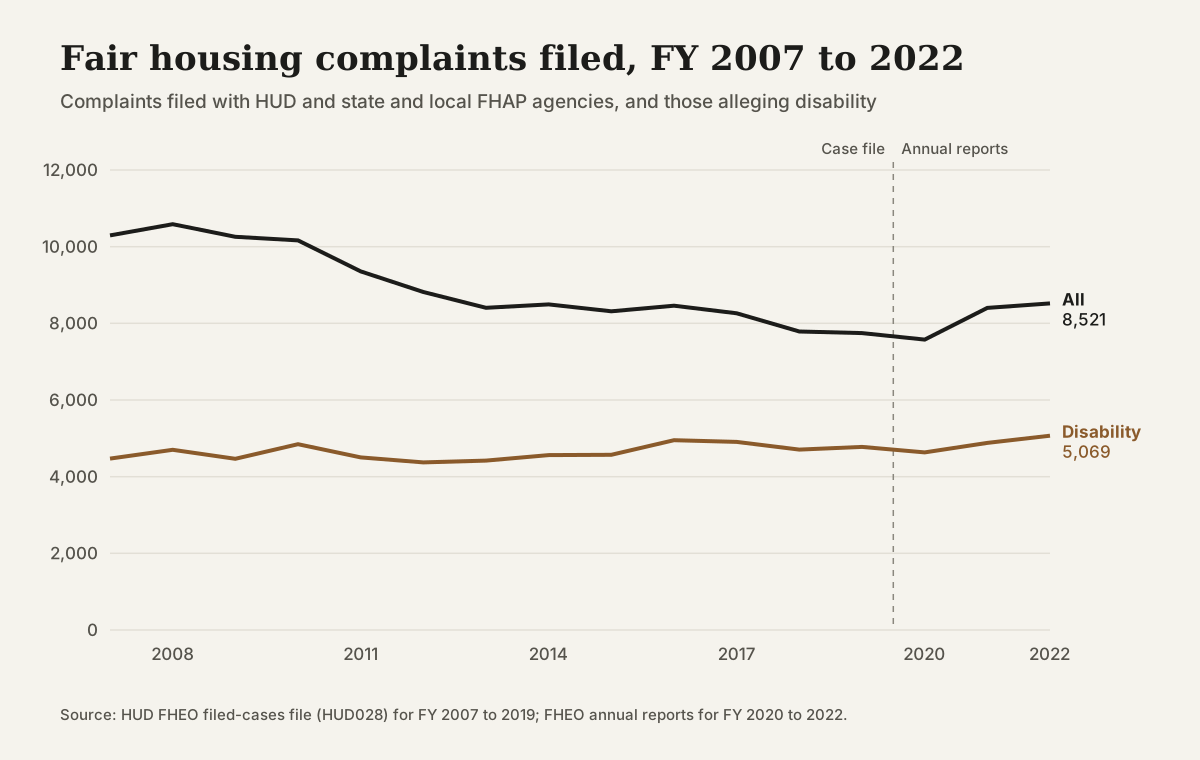
Fair housing complaints filed with HUD and FHAP agencies, and those alleging disability, FY 2007 to 2022. Sources: HUD filed-cases file (HUD028) for FY 2007 to 2019; HUD annual reports for FY 2020 to 2022.
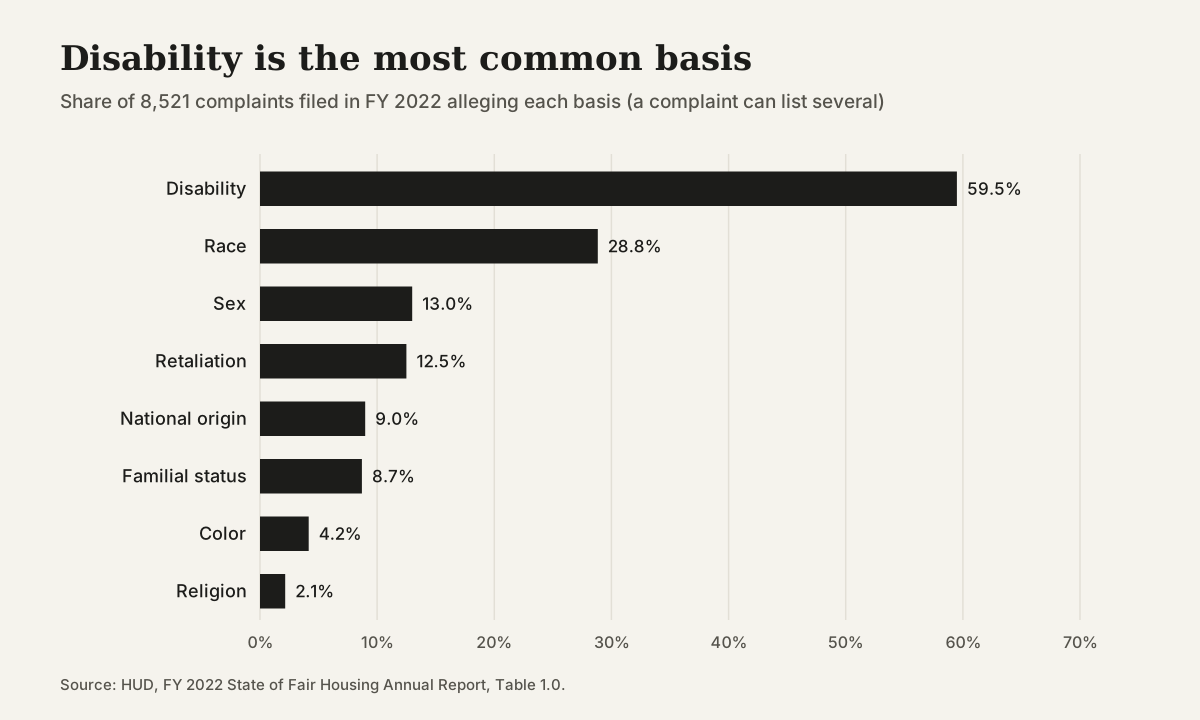
Share of fair housing complaints filed with HUD and FHAP agencies in FY 2022 alleging each basis. A complaint can allege several. Source: HUD, FY 2022 State of Fair Housing Annual Report.
Questions that come up
Does this page include fair housing lawsuits or complaints to private groups?
No. It counts administrative complaints filed with HUD or a state or local FHAP agency. Lawsuits filed directly in court, cases the Justice Department brings on its own and complaints made only to private fair housing organizations are not included.
Is source of income a federally protected class?
It is not on HUD's list of characteristics the federal Fair Housing Act protects. Whether a state or local law covers it depends on where the property is, so check the rules that apply there.
Does this page say whether a landlord broke the law?
No. A complaint is an allegation, and many close with no cause found. The figures describe what was alleged and how cases ended, not whether any practice was unlawful.
When will newer complaint data be available?
HUD had not announced a date in the sources used here. When we checked on October 24, 2026, the latest annual report on hud.gov covered FY 2022.
Sources and references
Follow each source to check the underlying claim. Access checks and professional review are different steps.