The short answer
Usually less than $100 a month, but it depends on the type of home. In 2023, owner-occupied households that paid an association fee paid a median of $81 a month, our tabulation of the American Housing Survey shows. Condo owners paid a median of $331 and owners in other homeowners' associations $54. Manufactured homes are excluded.
Key takeaways
The key numbers
The American Housing Survey, run by the Census Bureau for HUD, asks households whether their home is a condominium, whether it is part of a homeowners' association, and how much they pay in association fees each month.
55.4% of fee-paying owners paid under $100 a month, but a minority paid far more, so the average ($243) sits well above the median ($81).
| Measure | Estimate |
|---|---|
| Owner households in a condo or homeowners' association | 27.7% (±0.6) |
| Renter households in a condo or homeowners' association | 12.8% (±0.6) |
| Occupied condo units that are renter-occupied | 39.5% (±1.7) |
| Owner households paying an association fee (not manufactured homes) | 20.0 million |
| Median monthly fee, owner households paying one | $81 (±4) |
| Middle half of owner fees (25th to 75th percentile) | $30 to $253 |
| Median monthly fee, condo owners | $331 (±14) |
| Median monthly fee, owners in a non-condo HOA | $54 (±4) |
| New single-family houses completed in an HOA, 2025 | 64% |
How many homes are in an HOA or condo association?
More than one in five occupied homes. In 2023, 22.5% of occupied homes were condos or part of a homeowners' association: 27.7% of owner-occupied homes and 12.8% of renter-occupied homes. Some homes are both a condo and part of a homeowners' association (5.0% of occupied homes).
Condos are where rentals and associations meet most. Of the 8.6 million occupied condo units, 3.4 million, or 39.5%, were renter-occupied, and renter households lived in condos slightly more often than owners did (7.4% vs 6.0%).
Cooperatives cannot be shown separately because Census withholds cooperative status from the public file, and 1.0% of households did not report association membership.
How much are HOA and condo fees?
In 2023, 20.0 million owner-occupied households outside manufactured homes reported paying an association fee. Their median was $81 a month; a quarter paid $30 or less, a quarter paid $253 or more, and one in ten paid $491 or more. 37.7% paid under $50 a month.
The split by type of association is wide. Condo owners paid a median of $331 a month, against $54 for owners in homeowners' associations that are not condos; the difference is statistically significant. In Census's definitions, condo fees pay for running and upkeep of shared property and its administration, while homeowners' association fees pay for services such as common-area upkeep. The survey does not measure why fees differ.
Not everyone in an association reports a fee. Among owner-occupied households in a condo or homeowners' association (outside manufactured homes), 9.6% reported paying no fee and 6.6% did not report an amount.
| Monthly fee | Share of fee-paying owners |
|---|---|
| Under $50 | 37.7% (±1.4) |
| $50 to $99 | 17.7% (±0.9) |
| $100 to $149 | 8.4% (±0.7) |
| $150 to $199 | 5.9% (±0.6) |
| $200 to $299 | 9.6% (±0.7) |
| $300 to $499 | 11.0% (±0.8) |
| $500 or more | 9.6% (±0.6) |
How do fees differ by type of home and region?
Fees were higher for homes that share more of a building. Owners of detached houses who paid a fee had a median of $48 a month, owners of attached houses or townhouses $253, and owners of units in buildings with 2 or more units $412. Each difference is statistically significant.
By region, the Northeast had the highest median ($301), followed by the West ($113), the South ($62) and the Midwest ($50). Each regional difference is significant by our test. The South held 48.0% of fee-paying owners. The survey does not explain the regional pattern.
| Group | Median monthly fee | Share of fee-paying owners |
|---|---|---|
| Condominium | $331 (±14) | 23.2% |
| Homeowners' association, not a condo | $54 (±4) | 74.7% |
| Detached house | $48 (±3) | 71.3% |
| Attached house or townhouse | $253 (±13) | 13.8% |
| Unit in a building with 2 or more units | $412 (±20) | 14.8% |
| Northeast | $301 (±31) | 9.6% |
| West | $113 (±16) | 25.2% |
| South | $62 (±4) | 48.0% |
| Midwest | $50 (±7) | 17.3% |
Have HOA fees gone up?
Census's published median rose in each survey from 2015 to 2023, from $58 to $83 a month, not adjusted for inflation. These published figures cover all occupied homes and include manufactured home park fees, so they are not the same measure as the owner figures above.
The definitions changed along the way. From 2021 the fee definition says it can be paid by either an owner or a renter, and Census's table row changed from fees paid by owners to fees paid by occupants. Comparing only 2021 and 2023, the published median rose from $72 to $83, a difference that is statistically significant by our test using Census's published margins. The number of households with a fee, including those that did not report the amount, rose from 20.5 million to 22.9 million. The 2017 to 2019 change, $1, is within the published margins.
| Survey year | Median monthly fee | Households with a fee (millions, including amount not reported) | Census row label |
|---|---|---|---|
| 2015 | $58 (±4) | 16.5 | Fee paid by owners |
| 2017 | $62 (±5) | 18.1 | Fee paid by owners |
| 2019 | $63 (±5) | 19.1 | Fee paid by owners |
| 2021 | $72 (±6) | 20.5 | Fee paid by occupants |
| 2023 | $83 (±4) | 22.9 | Fee paid by occupants |
Are new homes more likely to be in an HOA?
Yes. In 2025, 64% of new single-family houses completed were in a homeowners' association, up from 46% in 2009, the first year in Census's table. For new houses sold, the share was 79%, against 62% in 2009. Census gives a standard error of about 3 percentage points on the 2025 completed share.
In these tables, an HOA is a legal body that looks after a development's shared areas and enforces its deed rules; it is normally formed when the development is built, and joining is required. The completed-house figures include houses built for rent.
Do renters pay HOA fees?
Not in this survey's data. Although the fee definition allows for renters, in the 2023 public file the fee amount is marked not applicable for 95.8% of renter households, and no renter household outside a manufactured home reported a fee amount. The survey therefore cannot show what owners of rented condos or HOA homes pay.
The owner-occupied figures on this page are the closest national guide, with the caveat that fees on rented homes may differ.
What this means for landlords
These are considerations to weigh against your own property, not recommendations.
- A national median says little about one association. A quarter of fee-paying owners paid $30 a month or less and one in ten paid $491 or more, so the association's own budget and fee history are the figures to use.
- For the typical fee-paying owner the fee was a small share of housing costs: by our calculation the median fee was 4.1% of the household's total monthly housing costs, and for a quarter of fee payers it was 14.5% or more.
- Condos and units in shared buildings carry the highest fees in the data ($331 and $412 medians), so fees weigh more on a condo rental's numbers than on a detached house's.
- Association rules on renting vary; check the governing documents before buying a home to rent out.
- Fees sit alongside other fixed costs. Our pages on property taxes and insurance costs track those.
Methodology
Membership and fee figures are our tabulations of the 2023 American Housing Survey national public use file, the latest AHS as of October 24, 2026. HUD is moving the survey to continuous collection, which Census said would begin in January 2026 or later. We count occupied homes, with owner-occupied meaning owned or being bought and renter-occupied meaning rented or occupied without payment of rent, as in the AHS definitions.
The fee is the survey's monthly homeowner or condominium association fee amount, which combines homeowner, condominium, cooperative and manufactured home association fees, manufactured home park fees and manufactured home hookup fees; amounts reported yearly are divided by 12. Our owner fee figures exclude manufactured homes, so park fees are not mixed with association fees, and count only households reporting a fee above $0.
Margins of error use the file's 160 replicate weights and Census's replicate-variance formula, at 90% confidence; medians are computed for the full sample and each replicate, and differences we describe are significant at that level. To check the tabulations, we matched 16 published 2023 figures in Census's table-specification workbook, including the all-home fee bands, the median of $82 and the mean of $244. Census adds noise to fee amounts in the public file, so its Table Creator figures can differ slightly.
Census's $82 median covers all occupied homes, including manufactured home park fees; our $81 covers owner-occupied homes outside manufactured homes. The 2015 to 2023 trend uses Census's published Table Creator estimates for all occupied homes. We test the 2021 to 2023 change with the published margins as if the two samples were independent; the AHS revisits the same housing units selected in 2015, so this likely makes the test conservative. New-home shares come from Census's Characteristics of New Housing tables, published July 1, 2026. All values are rounded once from unrounded data.
Source: U.S. Census Bureau and U.S. Department of Housing and Urban DevelopmentSource: U.S. Department of Housing and Urban Development and U.S. Census BureauSource: U.S. Census BureauSource: U.S. Census BureauSource: U.S. Census BureauSource: U.S. Census BureauSource: U.S. Census BureauSource: U.S. Census BureauSource: U.S. Census Bureau
Limitations
Keep these limits in mind.
- Fees are household reports, and amounts in the public file have noise added by Census. Many amounts are round yearly figures divided by 12.
- The AHS asks about required association fees and how often they are due; neither the question nor Census's definition mentions special assessments, so this page does not cover them.
- Figures are national and regional. They do not show fees in a particular state, city or association.
- Fees on rented homes are not collected, except in manufactured homes, so the fee figures describe owner-occupied homes.
- Cooperative status is withheld from the public file. Co-ops that are also in a homeowners' association are counted in the "homeowners' association, not a condo" group, and other co-ops in the small group outside condos and homeowners' associations.
- Census's published trend mixes owner and, from 2021, occupant wording, and includes manufactured home park fees; dollar figures are not adjusted for inflation.
- This page does not forecast fees for any property.
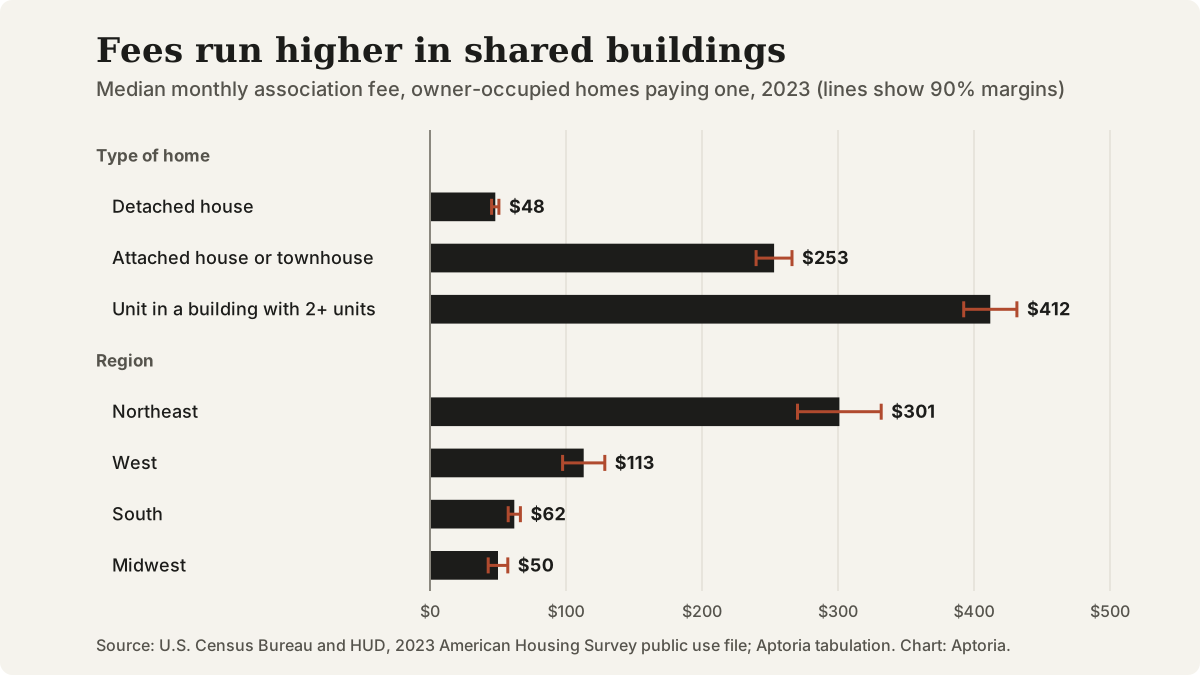
Median monthly association fee paid by owner-occupied households that pay one, by type of home and region, 2023, manufactured homes excluded. Source: American Housing Survey public use file; Aptoria tabulation.
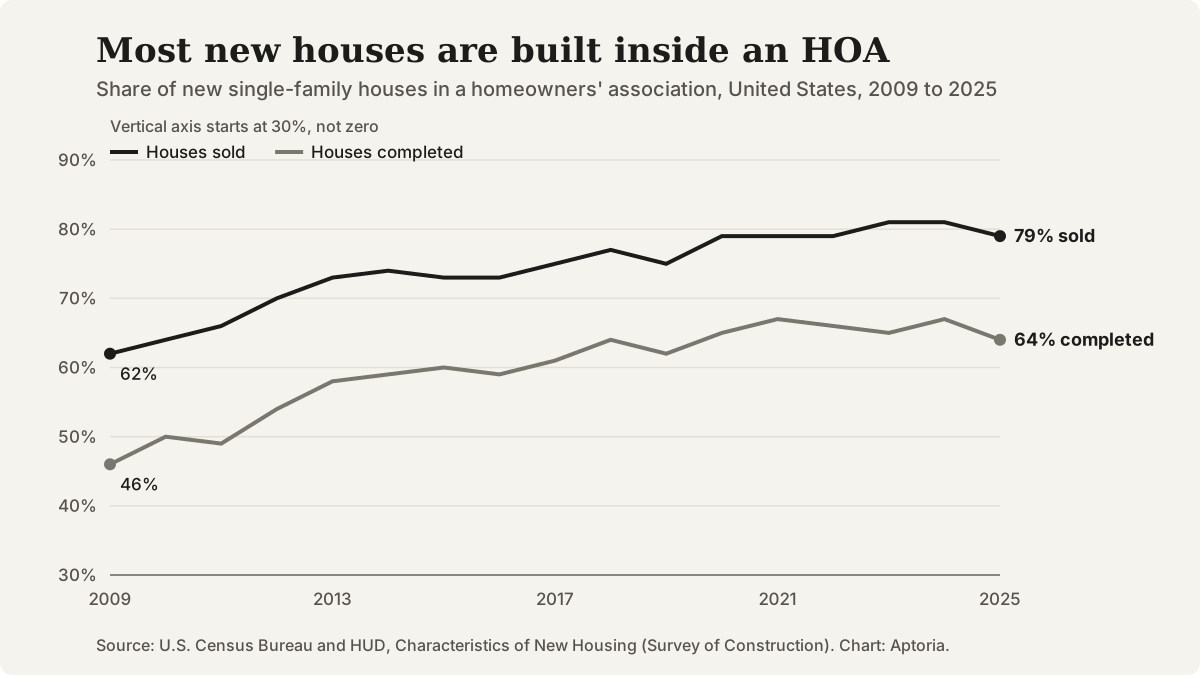
Share of new single-family houses completed and sold that were in a homeowners' association, 2009 to 2025. Source: Census Bureau and HUD, Characteristics of New Housing.
Questions that come up
Why is the median HOA fee so low?
Many homeowners' associations for detached houses charge small dues; owners of detached houses who paid a fee had a median of $48 a month, and the survey converts yearly dues to a monthly amount. Condo fees are much higher, with a median of $331.
Does this page include manufactured home park fees?
Our owner fee figures exclude manufactured homes. Census's own published median, used for the 2015 to 2023 trend, covers all occupied homes and includes manufactured home park and hookup fees.
Does this page cover co-op maintenance fees?
Only partly. Co-op fees are included in the survey's fee amount, but Census withholds co-op status from the public file, so co-op fees cannot be shown on their own.
When will newer HOA fee figures be available?
Census released national American Housing Survey data every other year through 2023, the latest available as of October 24, 2026. HUD is moving the survey to continuous data collection, so the timing of the next release has not been announced. Census's new-home tables are published each year; the 2025 tables came out July 1, 2026.
Sources and references
Follow each source to check the underlying claim. Access checks and professional review are different steps.