The short answer
Not at the moment, on balance. In the Federal Reserve's July 2026 survey of senior loan officers, 9.4% of responding banks said they had tightened standards for multifamily loans and 15.1% had eased them, a net percentage of -5.7. That follows 14 surveys in a row with a positive net percentage, peaking at 65.5 in October 2023, although the Fed described the last four, in 2025, as basically unchanged.
Key takeaways
The key numbers
A positive net percentage means more banks tightened standards (or saw stronger demand) than eased them (or saw weaker demand) over the three months before each survey. A negative number means the reverse. The figures describe the direction of change, not how strict standards are.
| Measure | July 2026 | April 2026 | January 2026 | July 2025 |
|---|---|---|---|---|
| Standards, all respondents | -5.7 | 0.0 | -5.5 | +4.8 |
| Standards, large banks | -15.0 | -15.8 | -22.2 | -28.6 |
| Standards, other banks | 0.0 | +7.3 | +2.7 | +22.0 |
| Demand, all respondents | -3.8 | +3.3 | -1.9 | -3.2 |
| Demand, large banks | +15.0 | +26.3 | +29.4 | +33.3 |
| Demand, other banks | -15.2 | -7.3 | -16.2 | -22.0 |
What did banks report in the latest survey?
In the July 2026 survey, which covers roughly April to June 2026, 5 of the 53 domestic banks that answered the multifamily question said they had tightened standards somewhat, 8 had eased somewhat and 40 reported no change. None reported changing standards considerably. The Fed's net percentage was -5.7, which it describes as a modest net share easing.
Results split by bank size. Large banks, those with $100 billion or more in domestic assets, had a net percentage of -15.0, meaning more of them eased. Among other respondent banks it was 0.0: as many tightened as eased.
Demand was basically unchanged overall at -3.8, but again it split: large banks reported stronger demand on net (+15.0) and other banks weaker demand (-15.2).
For other commercial real estate loans, standards eased more for nonfarm nonresidential property, such as office and retail buildings (net -11.3), while construction and land development loans were basically unchanged (-3.7).
How does that compare with 2020 and 2023?
The data file's multifamily series begins with the October 2013 survey. Since then, the net percentage has been positive, meaning net tightening, in 38 of 52 surveys and negative in 11.
Two episodes stand out. In 2020, the net share tightening jumped from 0.0 in the January survey to 49.2 in April and 64.3 in July. Banks shifted to net easing from the April 2021 survey, reaching -23.2 in the January 2022 survey.
The second began in the July 2022 survey. The net percentage was positive in 14 surveys in a row through October 2025, with the net share above 60 for most of 2023 and peaking at 65.5 in October 2023, about as high as in 2020. In the four 2025 surveys it was between 1.6 and 4.8, which the Fed describes as basically unchanged. Demand weakened at the same time: the net share reporting stronger demand fell to -72.6 in April 2023, the lowest in the series.
The tightening faded through 2024 and 2025. The January 2026 survey showed the first net easing since April 2022, April 2026 showed no net change, and July 2026 showed modest net easing again.
Before the October 2013 survey, the Fed asked about all commercial real estate loans as one category. That broader series reached 87.0 in the October 2008 survey, but it covers more than apartment loans and is not directly comparable.
| Survey | Net percentage tightening | What it reflects |
|---|---|---|
| July 2016 | +44.3 | Highest reading before 2020 |
| July 2020 | +64.3 | Peak of the 2020 tightening |
| January 2022 | -23.2 | Most net easing in the series |
| October 2023 | +65.5 | Highest reading in the series |
| October 2025 | +1.6 | Last of 14 positive readings in a row (Fed: basically unchanged) |
| July 2026 | -5.7 | Latest survey |
Are standards tight or loose compared with the past?
Easing for a quarter does not mean credit is easy. Each July, the survey asks banks where their current standards sit relative to the midpoint of the range their own standards have covered since 2005.
In July 2026, 32.7% of the 52 banks that answered for multifamily loans placed their standards on the tighter side of that midpoint and 21.2% on the easier side. The Fed describes this as a moderate net share reporting relatively tight multifamily standards, and says the net share reporting tighter-end standards was lower than in the July 2025 survey.
| Answer | Share of banks |
|---|---|
| Easier than the midpoint (all easier answers) | 21.2% |
| Near the midpoint | 46.2% |
| Tighter than the midpoint (all tighter answers) | 32.7% |
What do the survey terms mean?
The Fed defines the net percentage for standards as the share of banks that tightened (considerably or somewhat) minus the share that eased (considerably or somewhat). For demand, it is the share reporting stronger demand minus the share reporting weaker demand.
In its summaries the Fed calls a net percentage of 5 or less basically unchanged, above 5 and up to 10 modest, above 10 and up to 20 moderate, above 20 and below 50 significant, and 50 or more major.
Standards are a bank's policies for approving loan applications. Terms are the conditions in the loan contracts it approves, such as rate spreads and collateral requirements; this page covers standards and demand only.
What this means for landlords
These are considerations, not financial or lending advice.
- The survey describes the direction large banks moved over a quarter. It does not tell you whether a particular lender will approve a particular loan.
- Easier than last quarter is not the same as easy. In July 2026 more banks still placed multifamily standards on the tighter side of their range since 2005 than on the easier side.
- Results differed by bank size in July 2026, so experiences may vary from lender to lender.
- If a refinance or purchase loan is coming, the rent roll and lender package guide covers assembling documents, and the DSCR calculator shows how rent and debt payments compare.
- Loan pricing depends on interest rates as well as standards; the interest-rates explainer covers that side, and the multifamily delinquency page covers how existing loans are performing.
Methodology
We download the Fed's SLOOS data package (file prepared 2026-07-30) and the July 2026 survey summary and Table 1 with a script. The multifamily series are the net percentages of domestic banks tightening standards for, and reporting stronger demand for, commercial real estate loans secured by multifamily residential structures, for all respondents, large banks and other banks.
Each value in the data file is dated at the end of the quarter in which the survey was released, so the date ending in September 2026 is the July 2026 survey. We checked that mapping against the Fed's written summaries for the July 2026, April 2026, January 2026 and October 2024 surveys.
We also recomputed the July 2026 net percentages from the Table 1 response counts and confirmed they match the data file. Shares in the special-question table are our calculations from the Table 1 counts. Figures are shown as the Fed publishes them, to one decimal place.
Source: Board of Governors of the Federal Reserve SystemSource: Board of Governors of the Federal Reserve SystemSource: Board of Governors of the Federal Reserve SystemSource: Board of Governors of the Federal Reserve SystemSource: Board of Governors of the Federal Reserve SystemSource: Board of Governors of the Federal Reserve System
Limitations
Keep these limits in mind.
- The panel is up to 80 large domestically chartered commercial banks plus up to 24 branches and agencies of foreign banks, and participation is voluntary. The Fed generally leaves out banks with less than $2 billion in total assets, so smaller community banks are mostly not included, and because the panel covers only commercial banks and foreign bank branches, credit unions, Fannie Mae and Freddie Mac, and other nonbank lenders are not part of it.
- 53 domestic banks answered the multifamily standards question in July 2026, so each bank's answer is worth about 1.9 points of the net percentage.
- Each responding bank counts once in the net percentage, whatever its size or how much multifamily lending it does.
- The survey measures the direction of change over about three months, not the level of standards, except in the July special questions.
- The survey does not split multifamily loans by building size, so smaller apartment buildings are not shown separately.
- The October 2026 survey had not been published as of October 24, 2026; the Fed's calendar lists it for November 2, 2026.
- This page does not forecast lending conditions.
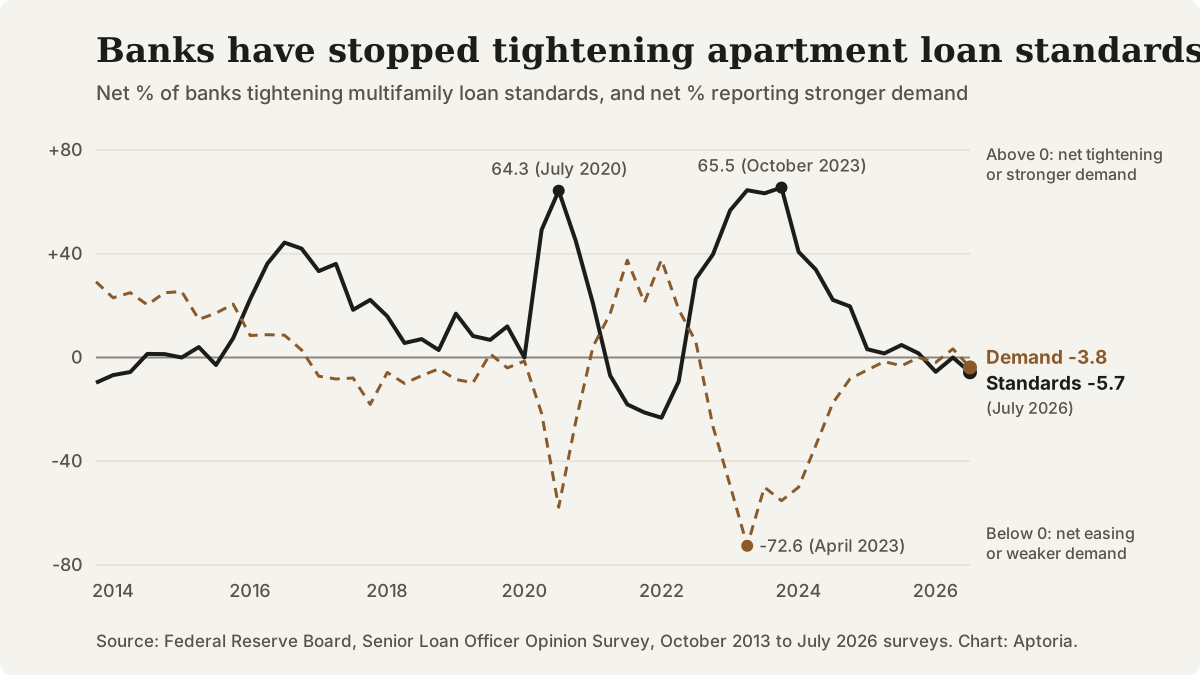
Net percentage of domestic banks tightening standards for, and reporting stronger demand for, multifamily loans, October 2013 to July 2026 surveys. Source: Federal Reserve Board, Senior Loan Officer Opinion Survey.
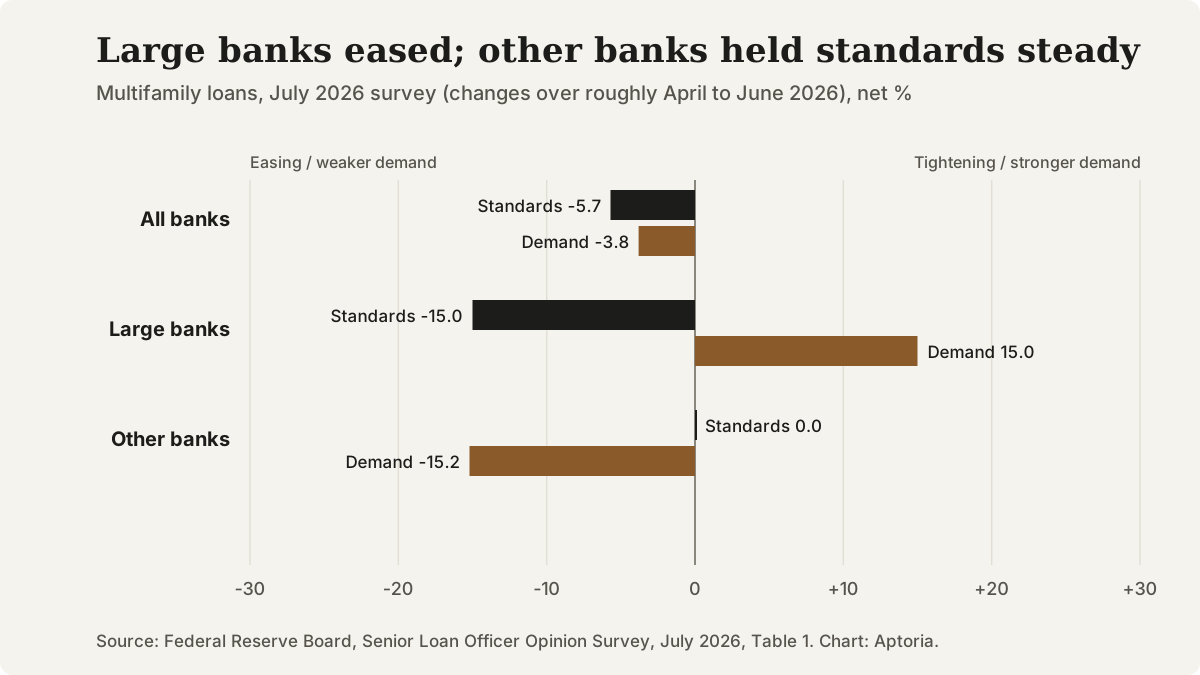
Net percentages for multifamily loan standards and demand by bank size, July 2026 survey. Source: Federal Reserve Board, Senior Loan Officer Opinion Survey, Table 1.
Questions that come up
When is the next survey published?
The Fed's calendar lists the October 2026 survey for release on November 2, 2026, at 2:00 p.m. Eastern. The Fed times the survey so results are available for its January/February, April/May, August and October/November policy meetings. This page is due for review once the results are out.
Does the survey cover community banks?
Not directly. The panel is up to 80 large domestically chartered commercial banks. In the Fed's tables, other banks are respondents with less than $100 billion in domestic assets, still drawn from that panel of large banks.
Does a negative number mean loans are easy to get?
No. It means more banks eased standards than tightened them over the past three months. In the July 2026 special questions, more banks still described their multifamily standards as tighter than the midpoint of their range since 2005 than easier.
Does this page say whether I will qualify for a loan?
No. It reports what a panel of large banks told the Federal Reserve about changes in their standards and the demand they saw.
Sources and references
Follow each source to check the underlying claim. Access checks and professional review are different steps.