The short answer
About 5.7 million households in fiscal 2025, by HHS's preliminary count. The exact figure for the 50 states and D.C. is 5,703,340, against 6.1 million in fiscal 2022, the latest final year. Most got heating help. In fiscal 2022, heating help reached about 15% of households HHS counts as federally income-eligible (our calculation).
Key takeaways
The key numbers
HHS counts households helped by the Low Income Home Energy Assistance Program from reports filed by states and D.C. The household total is unduplicated, but a household can get more than one kind of help, so the rows below add up to more than the total. Fiscal 2025 figures are preliminary.
Average benefits are what grant recipients report per household. HHS notes they are not directly comparable to funding divided by households, because funds obligated in one year can be spent in the next, and it does not collect an average for weatherization.
| Type of assistance | Fiscal 2025 (preliminary) | Fiscal 2022 (final) |
|---|---|---|
| Households served (unduplicated) | 5,703,340 | 6,070,331 |
| Heating assistance | 4,808,087 | 5,129,683 |
| Winter or year-round crisis assistance | 1,199,556 | 1,599,549 |
| Cooling assistance | 778,826 | 824,692 |
| Summer crisis assistance | 113,222 | 174,285 |
| Weatherization | 45,154 | 59,180 |
| Average heating benefit per household | $467 | $539 |
| Average cooling benefit per household | $711 | $584 |
| Average winter crisis benefit per household | $243 | $331 |
Is the number of households going up or down?
Since fiscal 2014 the count has stayed between 5 and 6.5 million households a year. It was highest in this period in fiscal 2015 (6.24 million) and lowest in fiscal 2021 (5.39 million). It rose to 6.07 million in fiscal 2022, then eased in the preliminary figures to 5.70 million in fiscal 2025.
Total program funding reported by grant recipients jumped during the pandemic, to $8.56 billion in fiscal 2021 from $3.74 billion in fiscal 2019. Those totals include one-time supplemental money: grant recipients reported $885 million in CARES Act funds in fiscal 2020, and HHS's fiscal 2021 Report to Congress shows states received about $4.43 billion in American Rescue Plan Act funds that year. The preliminary fiscal 2025 total is $4.23 billion.
Average heating benefits also rose, from $415 in fiscal 2019 to $539 in fiscal 2022. In preliminary fiscal 2025 data the average heating benefit is $467 and the average cooling benefit $711.
| Fiscal year | Households served | Total program funding | Data status |
|---|---|---|---|
| 2015 | 6,244,481 | $3.48 billion | Final |
| 2019 | 5,781,626 | $3.74 billion | Final |
| 2020 | 5,630,492 | $4.71 billion | Final |
| 2021 | 5,391,802 | $8.56 billion | Final |
| 2022 | 6,070,331 | $6.58 billion | Final |
| 2023 | 5,939,605 | $6.22 billion | Preliminary |
| 2024 | 5,876,646 | $4.28 billion | Preliminary |
| 2025 | 5,703,340 | $4.23 billion | Preliminary |
Who is eligible, and how many are reached?
Federal law sets the maximum: a household can qualify with income up to the greater of 150 percent of the poverty guidelines or 60 percent of its state's median income, depending on household size, and states may also serve households with a member receiving TANF, SSI, SNAP or certain veterans' benefits. States set their own income limits within that range, but cannot exclude a household on income alone if its income is below 110 percent of the poverty level, and can add other requirements, so being income-eligible does not guarantee help.
HHS estimates 34.0 million households were federally income-eligible in fiscal 2022. Heating assistance went to 5.13 million households that year, about 15.1% of the eligible count, and all forms of help together reached 17.9% (our calculations from HHS totals). In preliminary fiscal 2025 data, the heating share is about 14.0%.
The share varies widely by state. HHS's figures for fiscal 2022 range from 51.2% in New York to 1.0% in Arizona, with a median state of 14.1%. HHS's measure counts heating assistance only, so it does not capture cooling or crisis help. In fiscal 2022, six grant recipients (Arizona, D.C., Florida, Kentucky, Louisiana and Oklahoma) reported more cooling than heating households.
Help is concentrated in a few states. In preliminary fiscal 2025 data, New York alone served 1,159,724 households, about 20% of the national total, and the five largest programs (New York, Michigan, Pennsylvania, New Jersey and Ohio) served about 41%.
| State | Share receiving heating assistance |
|---|---|
| New York | 51.2% |
| Vermont | 37.1% |
| Iowa | 32.8% |
| Wisconsin | 30.1% |
| Michigan | 29.4% |
| California | 2.8% |
| Texas | 2.8% |
| South Carolina | 2.6% |
| Florida | 1.8% |
| Arizona | 1.0% |
| United States (our calculation) | 15.1% |
How many renters get energy assistance?
HHS's program reports do not split households into renters and owners, so this section uses EIA's 2020 Residential Energy Consumption Survey. It asked whether the household had taken part in a home energy assistance program that helps pay energy bills or fix broken equipment, and in which years. That covers LIHEAP but is not limited to it.
In 2020, 5.9% (±0.6) of renter households said they took part in such a program, against 2.3% (±0.3) of owner households. Renters made up about 55% of participating households (±4 points), but about 33% of all households (our tabulation). As in EIA's tables, renter households include those living in their home without paying rent.
Renters were also more likely to report a disconnect or fuel delivery stop notice in the past year: 16.9% against 6.6% of owners. Each of these renter and owner differences is statistically significant.
The survey's count of households reporting assistance in 2020, about 4.3 million, is lower than HHS's program count for fiscal 2020. The two measure different things: one is what households recall in a survey, the other is what states report for a federal fiscal year.
| Measure | Renter households | Owner households |
|---|---|---|
| Took part in a home energy assistance program in 2020 | 5.9% (±0.6) | 2.3% (±0.3) |
| Ever took part in a home energy assistance program | 8.9% (±0.9) | 3.5% (±0.3) |
| Received a disconnect or delivery stop notice in the past year | 16.9% (±0.7) | 6.6% (±0.4) |
What is LIHEAP's funding status?
LIHEAP is funded each year by Congress. ACF's budget documents show $4.025 billion for the block grant in fiscal 2025, and the Consolidated Appropriations Act, 2026 provided $4.045 billion for fiscal 2026, of which up to $9.6 million may be reserved for HHS technical assistance, training, monitoring and administrative expenses. ACF released the fiscal 2026 money in parts: $3.61 billion in block grant funds plus $100 million in infrastructure act funds on November 28, 2025, under a continuing resolution, and $421.5 million on April 17, 2026.
The President's budget requests for fiscal 2026 and fiscal 2027 both proposed eliminating LIHEAP funding. Congress funded the program for fiscal 2026. ACF's fiscal 2027 budget justification lists 15 full-time-equivalent LIHEAP staff in fiscal 2025, 1 in fiscal 2026 and 0 requested for fiscal 2027.
For fiscal 2027, which began October 1, 2026, ACF released $3.63 billion on October 9, 2026. That is 90% of the funding available under a continuing resolution signed September 2, 2026, not a full-year appropriation. The continuing resolution runs through December 11, 2026, unless Congress acts sooner.
Source: U.S. Department of Health and Human Services, Administration for Children and FamiliesSource: U.S. Government Publishing OfficeSource: U.S. Department of Health and Human Services, Administration for Children and FamiliesSource: U.S. Department of Health and Human Services, Administration for Children and FamiliesSource: U.S. Department of Health and Human Services, Administration for Children and FamiliesSource: U.S. Government Publishing Office
What this means for landlords
These are considerations to weigh against your own rentals, not legal or financial advice.
- Tenants who pay their own heating or cooling bills may be able to get help. Eligibility and application rules are set by each state program; ACF points households to EnergyHelp.us for how to apply.
- Renters report taking part in energy assistance programs more often than owners, about 6% against 2% in 2020, so some of your tenants may already use them.
- LIHEAP funding is set by Congress each year, and recent budget requests proposed ending it. The amount of help available in a given winter can change.
- Rules on utility shutoffs and on billing tenants for utilities vary by state and locality.
Methodology
Program figures come from HHS's LIHEAP Data Warehouse, which compiles reports filed by state and D.C. grant recipients and excludes territories and tribes that receive funds directly. We queried its national and state reports for fiscal 2014 to 2025 through the same public interface its web pages use. State rows add exactly to the national totals, and HHS's state percentages of eligible households served by heating help match heating households divided by eligible households. The warehouse marks fiscal 2023 to 2025 as not final; fiscal 2025 state data were uploaded as preliminary.
National shares of eligible households reached are our calculations: heating (or total) households divided by HHS's estimate of federally income-eligible households, which HHS builds from Census survey data.
Renter and owner figures are our tabulation of EIA's 2020 RECS microdata (18,496 households), using EIA's final weight and its 60 jackknife replicate weights for 90% margins of error. Before reporting them, the script reproduces 12 owner, renter and all-home counts in EIA's published Table HC11.1. Differences were tested at the 90% level. Figures are rounded once, at display.
Funding status comes from ACF funding release notices, ACF's fiscal 2027 budget justification, the Consolidated Appropriations Act, 2026 (Pub. L. 119-75) and the Continuing Appropriations and Extensions Act, 2027 (Pub. L. 119-103). This page reports what those documents say and takes no position on the program.
Source: U.S. Department of Health and Human Services, Administration for Children and FamiliesSource: U.S. Department of Health and Human Services, Administration for Children and FamiliesSource: U.S. Department of Health and Human Services, Administration for Children and FamiliesSource: U.S. Energy Information AdministrationSource: U.S. Energy Information AdministrationSource: U.S. Energy Information AdministrationSource: U.S. Department of Health and Human Services, Administration for Children and FamiliesSource: U.S. Government Publishing OfficeSource: U.S. Government Publishing Office
Limitations
Keep these limits in mind.
- Fiscal 2023 to 2025 figures are preliminary and can be revised; fiscal 2022 is the latest final year, and the fiscal 2022 Report to Congress is the most recent one HHS has published.
- States report the figures. HHS notes that some states with combined heating and cooling programs report those households under heating assistance, and some that give expedited heating help in a fuel crisis report the funds under heating but the households under crisis assistance. Comparisons between states should be read with that in mind.
- Because state reporting practices differ, this page does not rank states by average benefit.
- The renter and owner figures come from a 2020 survey and cover any home energy assistance program, not only LIHEAP.
- Income-eligible counts are estimates from Census survey data, and households counted as eligible may not meet a state's other requirements.
- Funding for fiscal 2027 had not been set for the full year when this page was written; the continuing resolution expires December 11, 2026. This page does not forecast funding or benefits.
Source: U.S. Department of Health and Human Services, Administration for Children and FamiliesSource: U.S. Department of Health and Human Services, Administration for Children and FamiliesSource: U.S. Energy Information AdministrationSource: U.S. Department of Health and Human Services, Administration for Children and FamiliesSource: U.S. Department of Health and Human Services, Administration for Children and FamiliesSource: U.S. Government Publishing Office
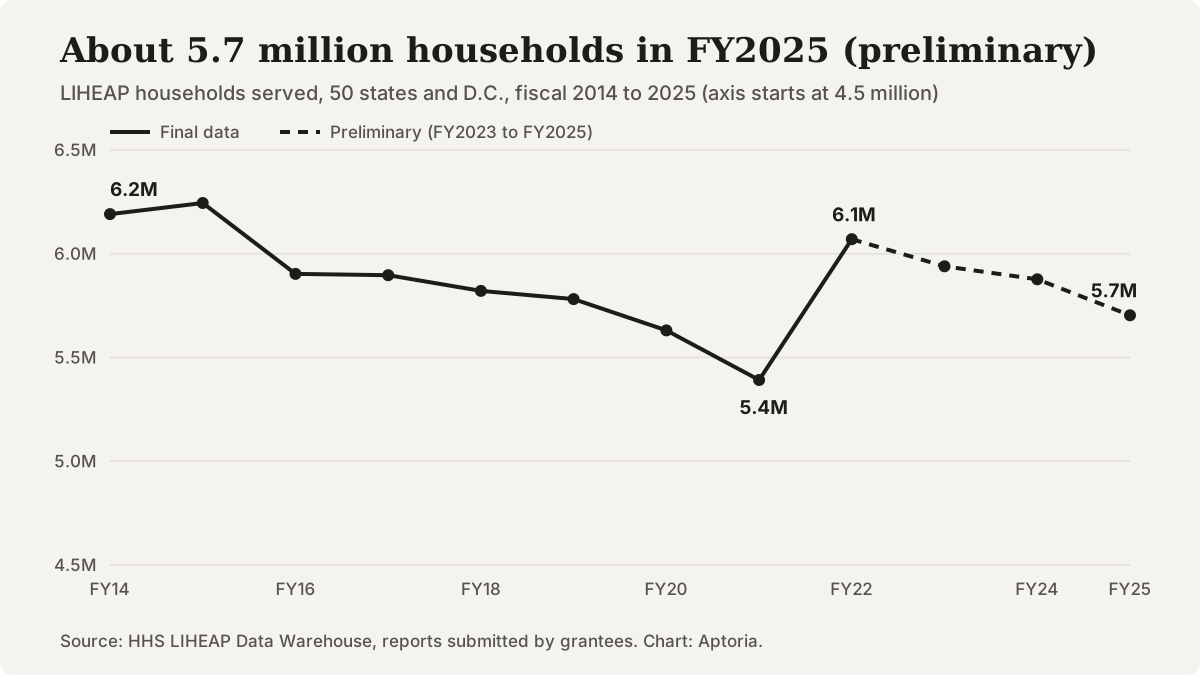
Households served by LIHEAP, 50 states and D.C., fiscal 2014 to 2025; fiscal 2023 to 2025 are preliminary. Source: HHS LIHEAP Data Warehouse.
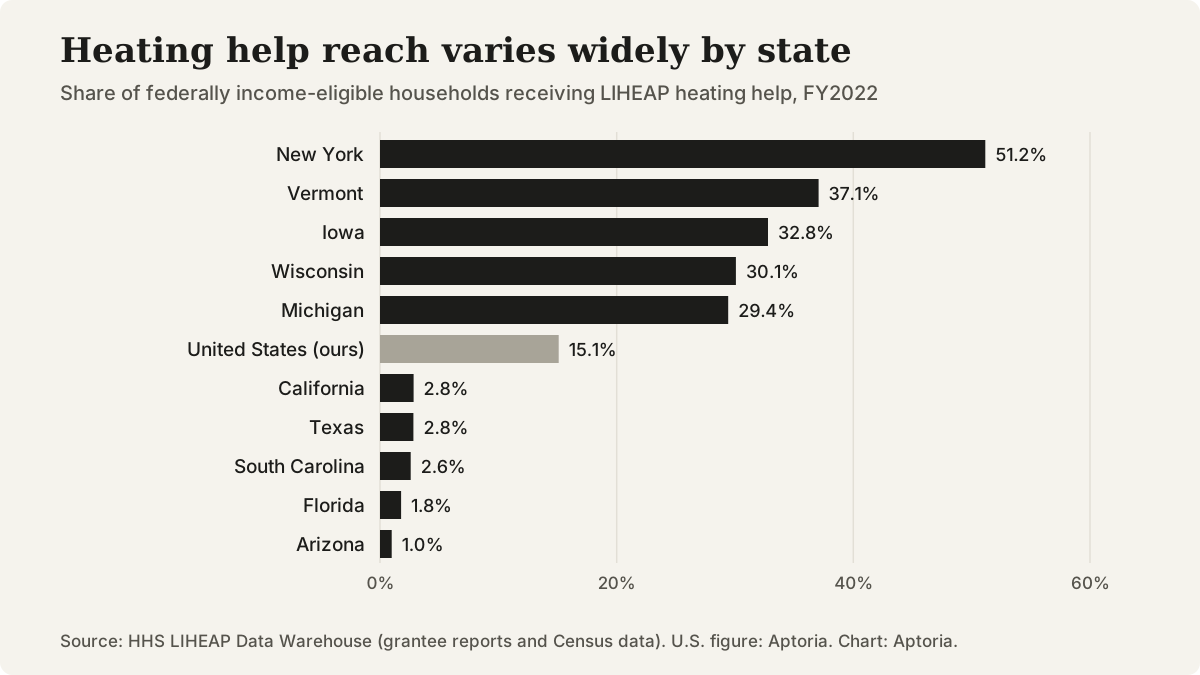
Share of federally income-eligible households receiving LIHEAP heating assistance, fiscal 2022, five highest and five lowest states. Source: HHS LIHEAP Data Warehouse; U.S. figure is Aptoria's calculation.
Questions that come up
Does this page say whether a tenant qualifies for LIHEAP?
No. It reports national and state program data. Each state sets its own income limit within the federal maximum and can add other rules, so a tenant should check with the state or local LIHEAP office. ACF points households to EnergyHelp.us for how to apply.
Does LIHEAP help renters whose heat is included in the rent?
This page's data cannot say. HHS's program reports do not split households by whether they rent or how they pay for heat. Federal law requires states to treat owners and renters equitably, and each state sets its own eligibility and benefit rules in its LIHEAP plan. The state LIHEAP office can say how its program treats households whose heat is included in rent.
Is LIHEAP being eliminated?
The President's budget requests for fiscal 2026 and 2027 proposed ending LIHEAP funding. Congress funded it for fiscal 2026, at $4.045 billion in the Consolidated Appropriations Act, 2026, and ACF released fiscal 2027 money in October 2026 under a temporary continuing resolution. Full-year 2027 funding had not been set when this page was written, and the continuing resolution expires December 11, 2026.
Why are recent years marked preliminary?
HHS's LIHEAP Data Warehouse lists fiscal 2023 to 2025 as not final, and HHS says data for those years should be considered "preliminary pending final data validation," so recent numbers can change.
Sources and references
Follow each source to check the underlying claim. Access checks and professional review are different steps.