The short answer
About 1,000 square feet. Census's Characteristics of New Housing puts the median at 1,000 square feet for multifamily units built for rent and completed in 2025, a figure that includes each unit's share of hallways and lobbies. About half were studios or one-bedrooms, 99% had central air and 87% had individual laundry.
Key takeaways
The key numbers
All figures are Census estimates for new multifamily units completed and built for rent, from its annual Characteristics of New Housing tables for 2025, published July 1, 2026. Census rounds counts to thousands and shares to whole percents. The last column is the error Census prints with each table, as a percent of the estimate for counts and sizes and in percentage points for shares.
| Measure | 2015 | 2025 | Census standard error, 2025 |
|---|---|---|---|
| Units completed | 304,000 | 461,000 | 7% of the estimate |
| Median square feet per unit | 1,057 | 1,000 | 1% of the estimate |
| Average square feet per unit | 1,109 | 1,044 | 2% of the estimate |
| In buildings averaging under 1,000 sq ft per unit | 38% | 49% | 2 points |
| Studios (efficiencies) | 5% | 8% | 1 point |
| One bedroom | 42% | 43% | 1 point |
| Two bedrooms | 43% | 39% | 1 point |
| Three or more bedrooms | 10% | 9% | under 0.5 point |
| One bathroom | 51% | 56% | 1 point |
| Two or more bathrooms | 44% | 41% | 1 point |
| Central air-conditioning | 93% | 99% | under 0.5 point |
| Individual laundry | 89% | 87% | 2 points |
| Electricity as heating fuel | 65% | 79% | 2 points |
| In buildings with 4 or more floors | 46% | 61% | 3 points |
| In buildings with 50 or more units | 47% | 59% | 3 points |
How big are new apartments?
The median new multifamily unit built for rent in 2025 had 1,000 square feet, and the average was 1,044. Census reports a relative standard error of 1% for the median; its methodology says that, with 90% confidence, the true value lies within about 1.6 times that either side of the estimate, which by our arithmetic is roughly 16 square feet either side. Across all new multifamily units, including the small number built for sale, the median was 1,004. Units built for sale had a median of 1,170, with a much wider relative standard error of 16%.
Census's square footage is not the same measure as the floor area a listing usually gives for one apartment. For multifamily buildings, Census counts all finished floor area plus associated living space, which it defines as hallways, elevator space, lobbies and other indoor space residents use. Census's table notes say the per-unit figure is the building's total square feet, based on exterior dimensions, divided by its number of units. By our reasoning, a unit's own interior space is therefore likely to be smaller than these figures.
About half of new rental units were in the smallest size class. In 2025, 49% were in buildings averaging under 1,000 square feet per unit, against 38% in 2015. Census places every unit in a building in one size class based on the building's average, so a building with a mix of studios and larger units is counted in a single class.
| Region | Median square feet | Census relative standard error |
|---|---|---|
| United States | 1,000 | 1% |
| South | 1,065 | 1% |
| Midwest | 976 | 2% |
| West | 969 | 3% |
| Northeast | 876 | 10% |
Are new apartments getting smaller?
Census's estimates are lower than a decade ago. The median for new units built for rent peaked at 1,117 square feet in 2011, was 1,057 in 2015 and fell to 998 in 2023, the lowest since the series began in 1999. It was 1,000 in 2025, below Census's estimate for every year from 1999 to 2022, though only 10 square feet below 2022, within the 2025 margin of error. The average moved the same way, from 1,131 in 2011 to 1,044 in 2025.
The bedroom mix shifted toward smaller units. Studios made up 8% of new rental units in 2025 against 5% in 2015, and two-bedroom units 39% against 43%. Studios and one-bedrooms together were about 52% of new rental units in 2025, by our calculation from Census's rounded counts.
Census's tables print standard errors for the latest year only, so this page does not test whether changes from earlier years are statistically significant. The tables also do not record why builders chose smaller units, and this page does not attribute the change to any cause.
Does size differ by region?
Yes, though some regional figures are imprecise. The median new rental unit was 1,065 square feet in the South, 976 in the Midwest, 969 in the West and 876 in the Northeast in 2025. By our test using Census's relative standard errors, only the South's median is clearly different from the others at 90% confidence; the Midwest, West and Northeast figures overlap once sampling error is allowed for. The Northeast figure has a relative standard error of 10%, so its true value could be well above or below the estimate. Census does not publish these tables for states or metro areas.
What features do new apartments have?
Central air is close to universal. 99% of new rental units in 2025 had central air-conditioning, against 93% in 2015; Census counts only central systems, not room or window units.
Most have individual laundry. 87% of new rental units had individual laundry facilities and 9% shared ones. Census's total also includes buildings with both kinds or with none, which it does not show separately, so the two shares add to less than 100%.
Most heat with electricity. Electricity was the heating fuel for 79% of new rental units in 2025, up from 65% in 2015, and gas for 21%, down from 35%. Census's gas category includes natural gas and propane.
Bathrooms: 56% of new rental units had one bathroom, 3% had one and a half and 41% had two or more.
What kinds of buildings are they in?
Mostly large, taller buildings. 59% of new rental units completed in 2025 were in buildings with 50 or more units, and 61% were in buildings with four or more floors. Census counts a basement as a floor only if it contains two or more housing units.
Many new rental buildings are small, though. Buildings with 2 to 4 units were 28% of the roughly 15,000 multifamily buildings completed for rent in 2025, by our sum of Census's shares (the 2-unit share has a standard error of 4 points, so it is imprecise, and it was 10% in 2024), but held under 3% of new rental units, about 12,000 of 461,000 by Census's rounded counts.
Nearly all new multifamily construction is for rent. By our calculation from Census's rounded counts, units built for rent were about 95% of the 484,000 multifamily units completed in 2025, against about 61% in 2006. The rest were built for sale, a category that includes condominiums and cooperatives.
| Units in building | Share of buildings | Share of units |
|---|---|---|
| 2 units | 18% | 1% |
| 3 to 4 units | 10% | 1% |
| 5 to 9 units | 10% | 2% |
| 10 to 19 units | 12% | 7% |
| 20 to 29 units | 21% | 15% |
| 30 to 49 units | 15% | 15% |
| 50 or more units | 15% | 59% |
What this means for landlords
These are considerations to weigh against your own market and properties, not recommendations.
- If you compare your unit's size with new construction, compare like with like. Census's figure includes a share of hallways and lobbies, so a typical new rental unit's own floor space is likely smaller than about 1,000 square feet.
- New competing units nationally tend to come with central air and individual laundry. Which features renters in your area expect is a local question that recent listings near your property can answer better than national data.
- Most new rental units heat with electricity. Applicants comparing your unit with a new one may weigh who pays utilities and how much; the utility cost trends page shows how electricity and gas prices have moved.
- New supply is concentrated in large buildings, but small buildings are still being built. Local permit and construction data show how much new supply is arriving where you own.
Methodology
All figures come from the U.S. Census Bureau's annual Characteristics of New Housing tables for 2025, published July 1, 2026, which are based on the Survey of Construction and partly funded by HUD. This page uses the multifamily units completed tables for units built for rent, plus the multifamily buildings table for building counts. Census defines built for rent as units built on the builder's land with the intention of renting them; the category includes retirement community units occupied under life-lease arrangements.
Square feet follow Census's multifamily definition and table notes: all finished floor area plus hallways, elevator space, lobbies and other indoor space residents use, divided by the number of units, based on exterior dimensions. In mixed-use buildings only the residential portion counts. Census computes medians and averages from unrounded data and shares from unrounded counts.
Census publishes average relative standard errors for counts and sizes and standard errors in percentage points for shares, printed under the latest year. Its methodology says that, with 90% confidence, the true value lies within about 1.6 times the relative standard error either side of the estimate. Census's figures are shown as published. Our own figures are the built-for-rent share of completions and the shares of units in 2 to 4 unit buildings and in studios or one-bedrooms, computed from Census's counts rounded to thousands, and sums of Census's rounded shares; these may differ by a point or so from what unrounded data would give.
Limitations
Read the numbers with these limits in mind.
- Square feet include a share of common areas, so they are not directly comparable with the interior floor area of a single apartment.
- Standard errors are published for the latest year only, so changes over time are not tested for significance here, and the standard errors do not measure nonsampling error such as reporting mistakes.
- Figures are national or by four census regions; Census does not publish them for states or metro areas.
- The tables describe new buildings completed in each year, not the existing rental stock. For the age and condition of existing rentals, see the rental housing age page.
- Single-family homes built for rent are not included; the build-to-rent page covers them.
- Census does not report rents or amenities beyond the items shown, and this page does not forecast what future buildings will offer.
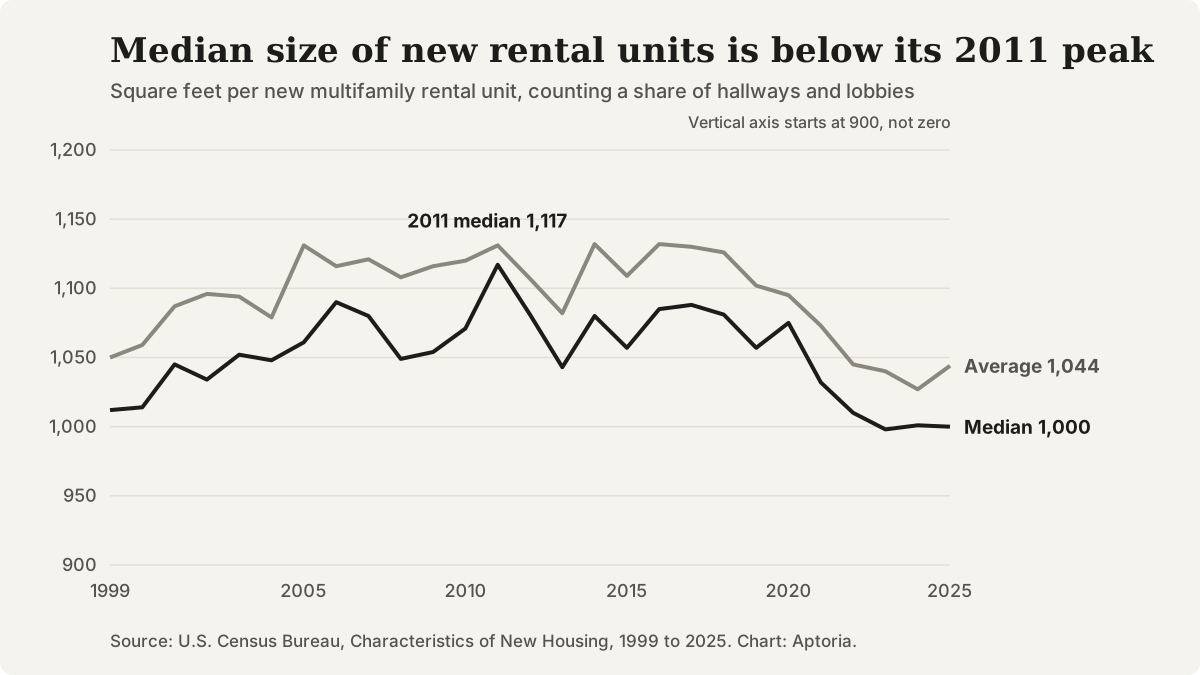
Median and average square feet per new multifamily unit built for rent, 1999 to 2025, including a share of common areas; the vertical axis starts at 900 square feet. Source: U.S. Census Bureau, Characteristics of New Housing.
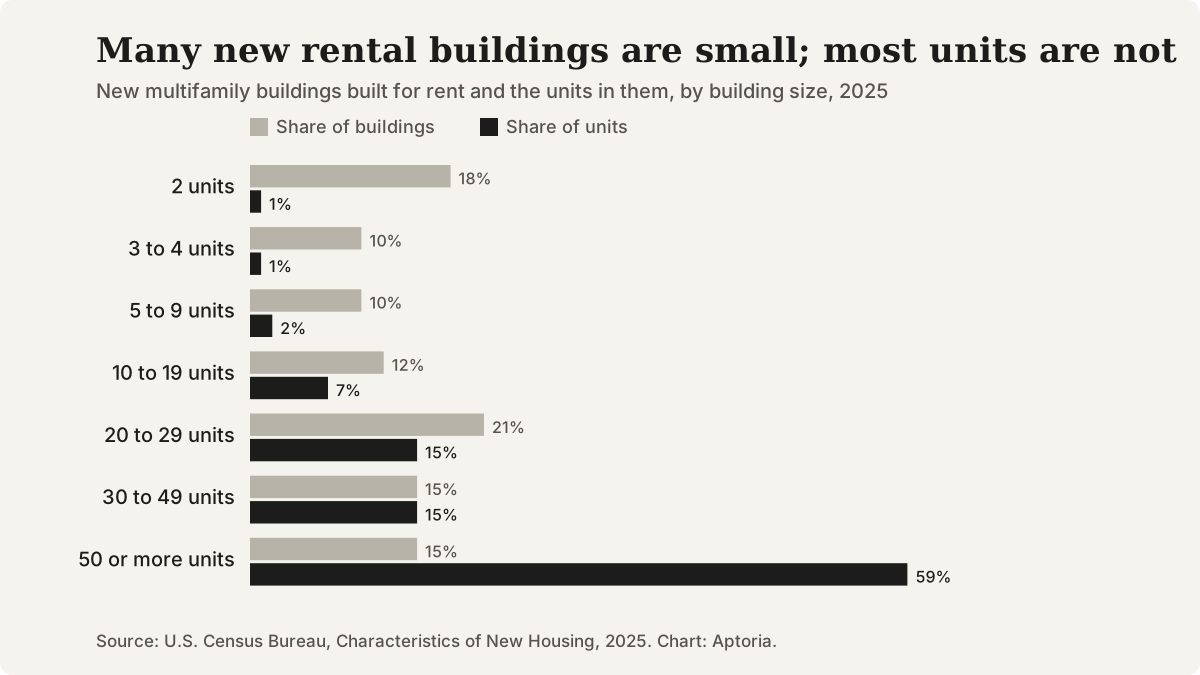
New multifamily buildings built for rent and the units in them, by building size, 2025. Source: U.S. Census Bureau, Characteristics of New Housing.
Questions that come up
Does this page measure apartment size the way a listing does?
No. Census's multifamily square footage includes each unit's share of hallways, elevator space and lobbies, measured from exterior dimensions. A listing usually describes one apartment's own space, which is likely to be smaller.
Does this page include single-family homes built for rent?
No. It covers units in buildings with two or more units, which Census classifies as multifamily. Single-family homes started and completed for rent are covered on the build-to-rent homes page.
Why are studios and one-bedrooms about half of new rental units?
Census reports how many units have each number of bedrooms, not why builders chose them, so this page does not give a reason. It reports the mix and how it has changed since 2015.
When will this page be updated?
Census published its 2025 figures on July 1, 2026. This page will be updated with the next annual tables when Census posts them; it does not have a release date for them yet.
Sources and references
Follow each source to check the underlying claim. Access checks and professional review are different steps.